Champagne and Rioja – compare and contrast

20130621-140040.jpg

Another week, another film about Rioja*. Super-Man can however rest at ease: this one though is unlikely to be a box office smash, burdened as it is with the unpromising title Regum Mensis Arisque Deorum. It’s latin, I’m told, for “For The Tables Of Kings And The Altars Of Gods”, and if it rings a faint wine-related bell it’s probably because you’ve been paying too much attention to bottles of Chateau d’Issan (the Bordeaux third-growth for whom it is a motto). The film, or an edit of it, was recently premiered at the Spanish embassy in London, and I was lucky enough to be invited (lucky because there was more to the evening than simply watching a promotional video with an ambassador – there was actual wine afterwards, of which more shortly).

As it happens, I went to another terrific tasting the following morning, the second being devoted to Veuve Clicquot’s various rosé Champagnes, and it was the contrast in the two presentations that most struck me (though the wines were also rather striking, so I’ll come on to them). The way these two historic wine-growing regions, Rioja and Champagne, choose to present themselves could hardly be more different. It started with the locations, one an old building full of oil paintings in gilded frames and enormous tables hewn from ancient oak, the other a modern architectural braindump hidden behind a historical facade, full of glass and bright colours and moulded plastic and little wall-embedded TV screens.

The presentations themselves offered a similar contrast. The Rioja film was full of wizened old souls, not so much wrinkled as viciously corrugated, pruning gnarly old vines with cigarettes hanging out of their mouths and crushing grapes using rudimentary antique hand-powered contraptions that look like leftovers from the Spanish Inquisition, when they would have been used to gently crush something else entirely. If you know nothing about Rioja beyond its self-produced publicity, you’d think all that happened there is the practice of centuries-old winemaking techniques by even older winemakers using older still equipment, all of it counterintuitively taking place in brand new buildings designed by Frank Gehry.

20130621-140431.jpg

Then there’s Champagne. Here, the impression is of the total absence of effort. Like everyone they send over to London Veuve’s chef de cave, Dominique Demarville (that’s him above), was impeccably presented in an immaculately-tailored suit. Rioja’s representatives need a translator to communicate in English; Champagne’s are born bilingual. Their hair, their clothes, their smiles and their handshakes all ooze class. Even their names do the job: I met the charming UK brand manager of Moët Hennessy, whose name is Arthur de Lencquesaing, a surname of such inherent poshness that you feel it should have its own Wikipedia page, just to be sure that all the world can find out about the history of Arthur’s forebears back to the 16th century. It is unsurprising, then, to discover that the surname has its own Wikipedia page so all the world can find out about the history of Arthur’s forebears back to the 16th century. If you knew nothing about Champagne beyond its self-produced publicity, you’d think that over there nobody ever sweats, most of them produce gently carbonated urine, and that every September or so millions of grapes gently pluck themselves from their vines and roll in an orderly line to the nearest winery, where they politely make themselves into fabulous fizz.

I’m not sure that either path is a particularly good one. Rioja would benefit from fostering a reputation for more than just architectural innovation (and has the wines and the people to do it), but its strategists seem traditionalists to the core. Meanwhile it’s hard to see the recent demand for grower Champagnes, wines made in small volume by real people, as anything but a backlash against the massive houses and their air of perfumed arrogance, even if there’s not yet much evidence of it on the shelves of Tesco.

20130621-143553.jpg

After the Rioja film, we were invited to settle around a table of extraordinary immensity to try eight gran reservas, starting with a 2005 CVNE Vina Real – young, modern but really very good – and heading back in time until we screeched to a halt with a 1964 Marques de Riscal, a stupendous and surprisingly youthful wine rapidly approaching its 50th birthday. Notable stop-offs along the way included a pair of 1994s, one excellent (Castillo Ygay), and one markedly less to my tastes (Marques de Caceres), and a fine example of the corner-shop staple Campo Viejo, from 1981, still going strongish (though it had aged faster than its peers, and I doubt it’ll see its half-century in much style).

Rioja continues to produce excellent wine at excellent prices – the Vina Real costs around £20, while the latest version of the Marques de Riscal costs between £28 and £38 pounds, which given that it’s already eight years old and is proven to have the capacity to live for another 40 and more, is not entirely unreasonable. Though you might have to actually go to Spain in order to find one, many gran reservas from, say, the excellent 1970 vintage can still be found for less than £100, which in the scheme of things is pretty good.

And so to the Champagne, where there was also evidence of relative value. Relative, that is, to exceptionally poor value. The basic range of Veuve roses consists of non-vintage, vintage, and La Grande Dame. The first costs around £40 and is a good wine of its type – “a beautiful success”, said Demarville, though I think he was talking commercially; the second in the region of £50-£55 and is extremely good – the latest release, 2004, is “one of the best vintage rosés we’ve ever made” and given the slender mark-up from the basic version is certainly the “value” option in the range; and the third will set you back about £250.

It’s a more refined beverage than its cheaper cousins, sure, but at present even if they cost the same I’d take the vintage over the big woman, in which Demarville detects more quinine (the slightly astringent flavour used to flavour tonic water) and I detect the flavour of humdrum Jewish Passover staple matzah. “This wine will be amazing in three or four years,” said Demarville, which is all well and good but the vintage is amazing already and if you buy that instead of the large lady you’ll save a not inconsiderable sum of money – enough for a couple of 1970 gran reservas, in fact.

There’s also the recently-launched “cave privee” series, which seems to be a way of getting shot of all the old stuff they’ve got lying around the basement. The current release here is the 1989 rosé, with future installments to include a 1990 rosé, a 1990 white, a 1982 white and a 1979 rosé. Demarville describes this as “a wine for connoisseurs, collectors and champagne lovers”, and is entirely right to do so – it’s a different beast entirely to less aged versions, copper-coloured rather than pink and with gentle, geriatric bubbles rather than the forceful fizz of youth. It’s a fascinating drink, and for all its age half the price of the Grande Dame, but is for those who take a particularly cerebral approach to their bubbles.

*I’m referring back to my last post, which you can find here.

‘The moment you describe wine, you are limiting it’

The Rioja Scrolls is a home-made film starring a couple of Masters of Wine, which is responsible for the disappearance of a little over half an hour of my life. It’s occasionally baffling, certainly indulgent and has a strange Indiana Jones-style plot device, which powers its stars through various Iberian japes. “A wine film that dares to be entertaining,” they say. Well, it certainly tries.

I’m not sure I’d recommend that you actually watch it all, but the film is not without interest. Hidden within, though, was an interesting interview with Mercedes López de Heredia, who co-runs Rioja’s excellent and storied bodega López de Heredia (their Gravonia white, released at around a decade old and sold in the UK for about £17, is really amazing stuff). She is asked to describe a 35-year-old wine which she has opened for the cameras, but recoils: “My grandfather never allowed us to describe the flavours in a wine because he said that from the moment you describe wine, you are limiting it,” she explained. “And we are wrong when we try to teach people to understand wine by helping them to describe it.”

It’s an interesting point. On the one hand, hearing or reading a list of what someone else thinks a wine tastes of is almost always exceptionally dull, and any rule that bans people from inflicting their lists on me has got something going for it. On the other hand, I think that tasting notes can be useful so long as you don’t recite them to others like some kind of particularly uninspired performance poet. And more than anything else I think that creating something for people to taste and then denying them the opportunity, and even the language, to describe the experience is bizarre. If you don’t want people to tell each other what your wine tastes of, make wine that doesn’t taste of anything. Remove from wine the ability to enjoy its flavour, to revel in it and consider it and, where appropriate, to discuss it and there’s no reason at all to drink it except inebriation.

The fact is, people like to tell each other about interesting things they see, touch, taste or hear. And we like to use previous experience to help us understand new ones. So we hear Daft Punk’s new album (very good) and we think it sounds like Chic and the Bee Gees. We read a book and consider which other authors use a similar style. So it is with wine, and each comparison helps us understand the subject better. 

But there are problems with describing flavour. One is that we don’t all perceive flavours the same way, and the other is that we don’t all use the same words to describe them. For example, Robert Parker loves to use the word “camphor” in his tasting notes. Camphor is “a white, volatile, crystalline substance, a terpenoid ketone, C10H16O, with an aromatic smell and bitter taste”. I have never seen, smelt, or tasted camphor. When Parker uses the word, I have no idea what he means. Other people might have no experience of other common descriptors – gooseberries, for example, are common in Europe and parts of Asia, but probably entirely unfamiliar to a Fijian or a Peruvian.

Even if two people speak the same language and have had the same previous sensory experiences, there simply aren’t as many words to describe flavour as there are flavours to describe. If we’re very skilled and very lucky we can choose the closest possible matches, but elements of our experience will still be lost, fallen between the cracks. We can say a New Zealand sauvignon blanc tastes of gooseberries and cat’s piss, and that gives you the general idea, but it’s just very vague shorthand. It’s like being hired to paint a portrait of the queen and delivering a stick man. So perhaps, in a way, describing a wine does limit it. In another, the wine simply exposes the limits of language. It’s frustrating, but that’s life – even when it seems sweet, it can leave a bitter taste in your mouth. A bit like camphor, really.

World Sherry Day – the longest day of the year is here

20130522-205445.jpg

I write this on the fourth day of World Sherry Day. Yes, you read that right, a day that has so far lasted four days, and there are a few more to come. World Sherry Day is, in fact, seven days long. You may well think that there is a perfectly good unit of temporal measurement that covers just such a time frame. But no, World Sherry Week simply would not do. Forget the Summer Solstice – this is the longest day of the year.

Winey days are all the rage at the moment – Syrah Day and Carignan Day were in February, Malbec World Day was in April and International Sauvignon Blanc Day just last week. Looking ahead World Cabernet Day happens every year in late August or early September, just a week or so before International Grenache Day – but sherry is trumping the lot. Its bloated extension has lead to an unfortunate clash: today, Thursday 23 May, will not only see World Sherry Day stretch beyond its 96th hour but also witness the cork pop on International Chardonnay Day. Rather disappointingly, particularly for fans of Portuguese fortified wine, World Port Day turns out to be an annual maritime event held in Rotterdam.

There is some logic behind most of the scheduling, with white wines celebrated just as the first rays of spring sunshine warm the backs of northern-hemisphere drinkers and red wines toasted as the leaves are pondering their autumnal colour change, or bang in the middle of winter. Forget wine-and-food matching, this is wine-and-season matching, and there is no wine for which it is more important than dry sherry.

If dry wine in general is an acquired taste – just try giving some to a child if you’re not sure (it would probably be wise to ask their parent first) – dry sherry is a taste to acquire after that taste is acquired. I have witnessed seasoned wine-lovers literally shriek with horror at the first sip of a fresh Fino, whose unique flavour comes from the time it spends in a barrel covered – and let’s not beat about the bush here – by a thick layer of fungal growth.

If you want to introduce someone, possibly yourself, to the joys of dry sherry you need to pick your moment. It makes no sense out of context. Supping it while there’s frost at the window would just be jarring, like welcoming dinner party guests by putting the Banana Splits Theme on the stereo, or decorating your child’s nursery with a full-scale replica of Picasso’s Guernica. But sitting outside on a warm afternoon, with a plate or two of something salty – cured ham works well, olives will do, salted marcona almonds are the absolute best – and condensation beading on the fridge-fresh bottle, it’s very fine indeed. If you’re in Spain it’s better still, but you may find almonds easier to arrange.

One of the cool things about dry sherry is the price. Really expensive ones simply don’t exist – they’re either cheap, or very cheap. If the queen decides to have a glass, it will come from a bottle that cost less than £15 (though if I were a trader I’d perhaps be tempted to bump prices up a bit if I saw a customer walk in wearing ermine and the Koh-i-Noor diamond). Hidalgo’s reliably good manzanilla La Gitana costs around £8 for a full bottle, but if we’re talking  royalty, the crown prince of dry sherries, Tio Pepe’s “En Rama” Fino, released each year since 2009 at the start of spring with a warning to have it drunk by the end of July, costs £13.95 at The Wine Society and is equally available from Adnams, Berry Bros, Lea & Sandeman and others. You can buy it by the half-bottle for an even cheaper fix.

Unlike most commercial sherries it is unfined, unfiltered and thus unstable, hence the need to drink up. Not usually a problem – it tends to hang around for even less time than World Sherry Day – but you do really need the sun to turn up at some point. When I met Antonio Flores, the winemaker, he described the En Rama as “wild, untamed Tio Pepe”, but then he’s not particularly scared of hyperbole. He also told me he expects drinkers to “experience a little bit of our cellars – that magical moment when time stops. It’s life in a glass.”

Dry sherry is not for everyone, but sweeter styles are very hard to resist. Having sipped your fino/manzanilla on the patio/roof terrace/postage-stamp-sized London garden with some pre-dinner nibbles, consider coming inside when it gets a bit chilly, sorting yourself out with some tangy cheese, or just some glasses, and opening a bottle of Matusalem, a sweet oloroso sherry from Gonzalez Byass (the people also behind Tio Pepe) that has been aged 30 years (and still costs a thoroughly non-ludicrous £15-£20 for a half-bottle, from Ocado, Tesco online and independents) and is seriously nutty, figgy, luscious and, at 20.5% abv, dangerously moreish. It can be hard to say no to another one, which is quite possibly also what the organisers of World Sherry Day thought when they came to schedule their celebration.

Wine, Indian food and failed chemistry experiments

20130510-142749.jpg

It was like a chemistry experiment in my mouth. One of the ones where you mix two things that look entirely harmless and everything suddenly starts going mental. If you don’t know what I mean, mix some bicarbonate of soda with laundry detergent and a bit of water to make a thick solution. Stand back and admire how dull and entirely bereft of action it appears. Now chuck in some vinegar and hide behind the sofa before the resulting explosion takes your head off see how it bubbles a bit. It was a sensation more surprising for being completely unexpected, like biting into an apparently standard chocolate cake and finding that it’s full of popping candy. Bad popping candy. Evil, mouth-assaulting, nasty popping candy.

Just like those chemistry experiments there were two principal ingredients. The first was a daal, an Indian preparation of pulses. On its own it seemed entirely benign, with little discernible chilli heat and instead delivering waves of mellow, gentle fruitfulness. It really was a tremendously good daal. The second was a German pinot noir, or spatburgunder as they have it there, from Bernhard Huber. Again, on its own it was bright, fruity, full of cherry-zapped freshness and low in tannins. But eat some daal and then, when it’s just gone down, sip the wine, and your mouth turns into a fiery cauldron, like you’d accidentally ingested a mouthful of tiny but very wild tannic chilli assault-gnomes.

20130510-142805.jpgAs I’ve previously said once or twice I’m not one for getting bogged down in the minutiae of wine and food matching, but I do think it’s worth avoiding absolute howlers. The unusual thing about this particular howler, however, is that the food and the wine were served together not, as you might assume, by a total idiot at a backstreet curry house but at a posh dinner at a top restaurant, a dinner designed to illustrate how well German wines match with Indian food (you may recall that not too long ago I wrote about a dinner designed to illustrate how well German wines match with Scandinavian food. You may deduce from this that the German wine people want the world to know how well their wine goes with a variety of cuisines, and you would be right). The location was the Cinnamon Club, round the corner from the Houses of Parliament, and the host was Jeannie Cho Lee, the Hong Kong-based Master (Mistress?) of Wine, who insisted that she would be happy to serve tannic wine with spicy food – so long as the person doing the eating and drinking was used to handling the spice. “It extends the sensation of heat,” she said, “but it’s fine if that’s your kind of thing.” What amazed me, as someone who isn’t used to handling the spice, was that it didn’t just extend the sensation of heat, it created it when none existed previously. This was a serious beverage fail.

The traditional British accompaniment to Indian food is lager, which quenches the thirst well enough but does little to douse the fiery flames caused by the ambitiously-ordered vindaloo. The correct accompaniment to Indian food, at least if you’ve got a slightly shy western palate like my own, is white wine that isn’t dry. Even if you’re having a venison curry, and everything you’ve ever read in the wine-and-food-matching rulebook about drinking wine with venison is screaming RED at you in a shrill voice, white wine goes best. Believe me – I’ve tried it. German labels are all sorts of complicated, but look for a spätlese Riesling, or go French with a demi-sec or a moelleux chenin blanc from Vouvray in the Loire Valley, or a rosé fruité of the sort you get by the pichet-full in unfussy provencal bistrots (but, unhelpfully, not many other places) for a couple of euros.

And if you want to know Jeannie Cho Lee’s basic rules for matching wine with Asian food (and I’ve filtered out absolutely all of the nuance in her detailed and well-thought-through presentation, because if you’re that interested you should just buy her book, or at least check out her website), they are these: 1) Because many Asian meals are composed of loads of different little mini-dishes all consumed at the same time, versatility is key – you can’t hit a nail on the head if you’re aiming at lots of nails and only have one hammer. I’m paraphrasing here, obviously. 2) So pick something cold, white and refreshing and everyone will be happy.

Some South African surprises

20130429-172814.jpg

High Timber is a South African restaurant delicately perched on the north side of the Millennium Bridge, close enough to one of London’s landmark river crossings for diners to enjoy a delightful walk from the South Bank without the need to negotiate traffic, yet far enough away for it to be all-but impossible to actually find. I went on the night of Margaret Thatcher’s funeral, which had been conducted round the corner at St Paul’s Cathedral earlier, and feared the place would be full of FW de Klerk and his chums, coming down from the emotional fireworks of the service in the company of some steaks and the occasional boerewors. Instead it was at best half-full; perhaps they’d got lost.

It was a night not just for eating South African, but drinking South African. A handful of wine merchants were there too, and had brought some of their favourite themed offerings, and we sat along the length of a generously-proportioned table and helped ourselves. The food was OK, and not enormous. The wine was excellent, and extremely plentiful. This left all present in a dangerous predicament, and I didn’t handle it well. I’ll cut a long story short: reader, I got drunk.

The cheapest wine on the table cost £10.75 a bottle, more than twice the average price of a bottle of South African wine sold in the UK (which was £4.68 the last time I looked, though there’s been another tax hike since). The most expensive costs a shade under £60 (the thrillingly good Mullineux Schist syrah). We got, in short, the good stuff. Most of the whites were blends taking chenin blanc as a given and then throwing in anything else that was handy at the time – sauvignon blanc, viognier, clairette blanche, chardonnay, rousanne and semillon all made an appearance in supporting roles. Some of these whites were very good indeed. The reds were fairly evenly divided between Bordeaux-style blends and syrah-dominated blends, with just one example of South Africa’s signature grape, pinotage.

(The pinotage was produced under the label Elemental Bob, the side project of Spookfontein winemaker Craig Sheard, who puts crystals in his wine barrels to improve their energy, or somesuch. It’s made in tiny quantities – just 400 bottles – and has a good story but I fear is one of those wines which is immeasurably improved by meeting its maker, and otherwise seems a bit expensive at £25.)

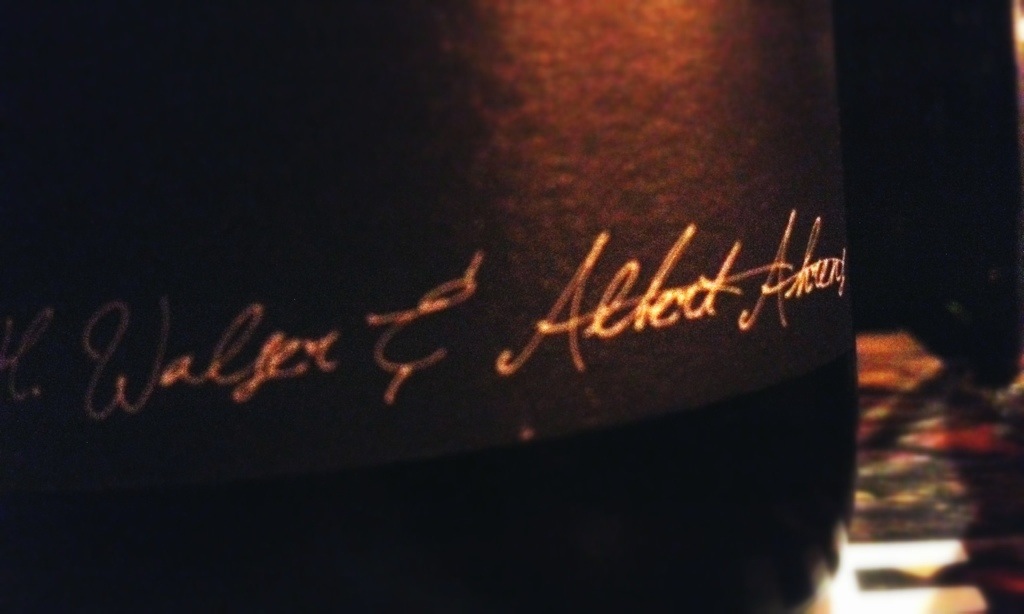
Wines of the night, then: I liked the Cape Point Isleidh white blend, a sauvignon/semillon that costs £31.99 from SAWinesOnline.co.uk; Cartology, a chenin/semillon blend that is refined, mineral, complex and very good value if you can find it at around £22-£23, and Mullineux white blend, a chenin/clairette/viognier (the latter, though just 9% of the blend, seemed to the fore) also very good value at £13. Of the reds, MR de Compostella, a blend of equal parts merlot, cabernet franc and cabernet sauvignon, with merlot and petit verdot sharing the last quarter of the blend, struck a fine balance between fruit and structure (£39, Handford wines), that expensive Mullineux syrah (their basic syrah is also excellent, for a similar price as the white), and the one I kept coming back to, BLANKbottle black, mostly syrah with a bit of other stuff, a soft, welcoming and all-round excellent wine from the fashionable Swartland (£25, or £23.75 by the case, Stone, Vine & Sun). The label, unsurprisingly given the wine’s name, is almost entirely black. The venue, I’m afraid, was almost entirely dark. This picture is the best I could do. If you’re unimpressed I do recommend that you buy some yourself and take your own photographs, it really is phenomenally drinkable.

20130429-172749.jpg

Britain’s best-value lunch?

20130407-113324.jpg

There’s lots of wonderful wine that I can buy, either as a regular indulgence or an occasional treat, but the very best, the most renowned, the greatest names, is now and will always be beyond me. There is a lot of wine, entire categories of wine, that is the reserve of the extremely, supremely, astonishingly or obnoxiously wealthy. Food, though, is far more democratic. The cheapest bottle of supermarket wine costs about £4, a bottle of 2009 Chateau Petrus 875 times as much, about £3,500. The cheapest supermarket sandwich costs about £1; a Big Mac meal costs £4.29; lunch at Britain’s second-best restaurant costs £35.

I’ve never been to the Fat Duck, widely considered Britain’s No1. It’s wildly expensive – £195 a head, to be precise, with no choices and no quibbling, so still quite cheap in wine terms – and booked up months in advance. But I go to l’Enclume quite often, most recently last weekend. L’Enclume’s great problem, hidden as it is on the edges of the Lake District, is that it’s nowhere near London, denying it the custom of quite a decent percentage of the nation’s wealthy gourmands. The advantage of this is that if you happen to be nearby, it’s pretty easy to get a table: mine, for lunch on a Saturday in the middle of the Easter holidays, was secured with a little over 12 hours’ notice.

It is incredibly good. Service is very friendly, even if there is a little too much of it and they are rather too fond of adjectives – tell me what’s on my plate by all means, but let me judge if the salt-baked beetroot is wonderful, or the caper jam is amazing. But the food is, at its worst, excellent, and very frequently several notches better than that.

And the price! For thirty five English pounds I received a glass of English fizz, six plates of culinary virtuosity, a selection of freshly-baked and very tasty bread rolls (which, when we’d finished them all, they offered to refresh) a coffee and a clever little petit four (I thought the coffee was going to cost extra, but it wasn’t on the bill and wasn’t added when I offered to pay). There was also a 17-course tasting menu for £96, which is the only option at dinner, plus an optional additional course of British and Irish cheeses.

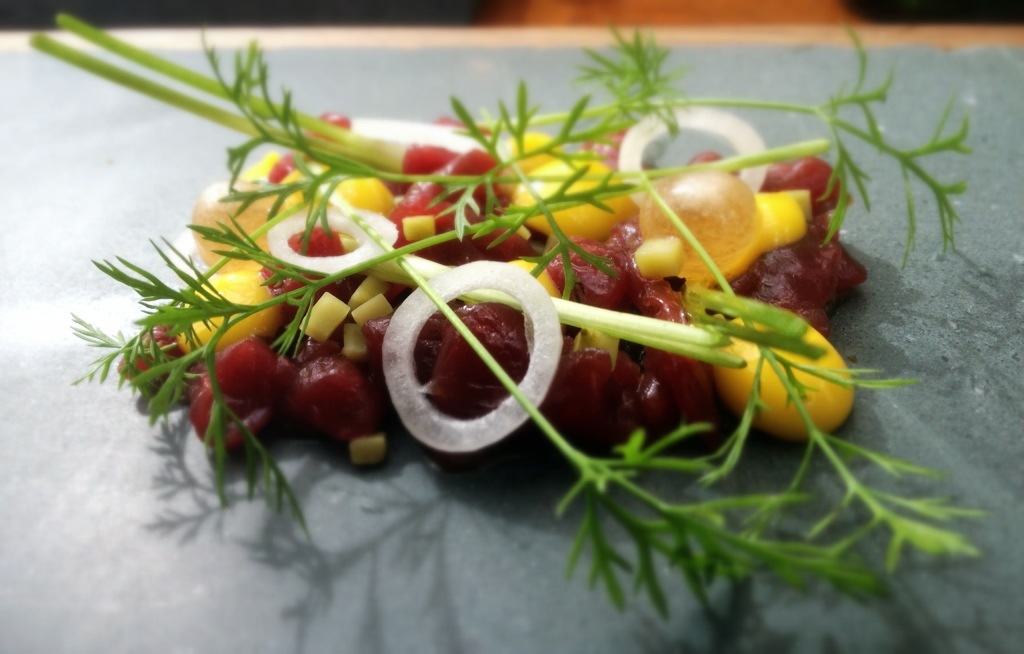
If I’m forced to have a quibble, it’s that of our six courses one had been there when I last came, perhaps six months ago, and another had been only slightly tweaked. But it would be churlish to complain, not when a couple of the dishes, including the raw venison, mustard, coal oil and fennel above, which contained two pearlescent fennel bonbons that all but prompted a standing ovation, and a rhubarb, apple, yoghurt and sorrel pudding, were genuine triumphs. I love their use of herbs to lift dishes, and their total avoidance of overly-sweet desserts. And if you go, don’t miss the village cheese shop (try to get some of the best local cheese – and when I say local I mean about a mile away – St James) and the priory.

20130407-162228.jpgI also went to the sister restaurant, Rogan & Co, a couple of minutes’ walk away. It’s good, though markedly less so than its big brother, and also less reliant on local ingredients. But while I wasn’t drinking at L’Enclume, what with having to drive to London a few hours later, at Rogan I enjoyed a bottle of one of my favourite wine-list wines, Pieropan’s Soave. Bright and light and beguiling, it’s one of those whites that is delicious with pretty much anything a dry white wine can be delicious with, including nothing at all. It cost £26 at the restaurant, about £13 from a shop (Laithwaites has it; at winedirect.co.uk it’s a bit cheaper, but it’s widely available from independents both here and in America). There’s only one other wine I’ve so far discovered that is equally good value, equally common in restaurants and equally good at it’s job – and as I’ve just bought a bottle, perhaps I’ll write about it soon.


My (first) moment in the spotlight

Five Wine Blogs I Really Click With - On Wine by Lettie Teague - WSJ.com

At the end of last week the real, proper wine writer Lettie Teague, writing in the actual, genuine Wall Street Journal, published an article about wine blogs, at the end of which she picked her five favourites. She’s American, her paper is American, the very great majority of her readers are American, and four of her chosen favourites were American too. From the entire rest of the world she picked one, and it was me.

I knew she might be writing about me – she’d been in touch by email, said she liked the blog, and asked me a few questions about it, and myself. But I also feel I have a decent sense of my place in the world. If I was going to be one of her selections, how many selections would there be? Surely no less than 20, I reasoned. WSJ wouldn’t want many more, even for a web-only piece; I surely wouldn’t be in there if there were to be fewer. When the article appeared, and I was one of five … well … I must admit it blew my little mind. And it also got my father quite excited, which is quite a feat in itself.

Inevitably, lots of people visited that weekend to check me out. Equally inevitably, many of them won’t be back. To any repeat visitors who first found me through that article: welcome. I hope you stick around. Hopefully we can have some fun together.

The simple secret to matching food and wine

20130327-212605.jpg

I have lost count of the number of times I have been talked through the basic rules of food and wine matching, each occasion more infuriating than the last. It’s not that there’s no truth in it, it’s just largely irrelevant. And the amount that some people go on about it is not just tiresome – I’m certain that it puts many people off wine entirely, stops many more from enjoying their wine, or leaves them feeling guilty if they do.

Sod the lot of them. Eat what you want. Drink what you want.

The first and most important question when considering a wine and food match is this: how many people are eating and drinking? If the answer is two, and in my house it normally is, then go no further. You will spend 10 minutes eating your food, and all evening, perhaps two evenings, on the wine. Make sure it’s a wine you want to drink; if you don’t like the way it tastes with your food, stop drinking it until you’ve finished the food. It’s OK.

If four or more of you are eating and drinking, then it’s theoretically both feasible and reasonable to attempt a good match. Now here’s problem two: it’s not hard to find a wine that will form a reasonable relationship with your food, but though the perfect match does exist, it’s bastard hard to achieve, requiring a detailed knowledge not just of the food, its ingredients and its method of preparation, but also of the wine itself. The key issue is this: I (and most people) rarely get more than a couple of bottles of any one wine, so when I pluck a bottle from my wine, um, cupboard, I’m to a certain extent in the dark: though I can hazard a guess at what it will taste like based on where it comes from and what it’s made of, I don’t really know until it’s open. And once it’s open I’m having it, whether it’s a perfect match or a useless one.

It’s hard to find a proper wine person who is quite so dismissive of the art of food and wine matching as myself. Which makes Mark de Vere something of a personal hero. He’s from Oxford, is entitled to suffix his name with the initials MW, which means he knows his wine, and works in California for Constellation Brands, the people behind Ravenswood’s zinfandels, Manischewitz kosher wine, Corona lager and lots of other booze, though he concentrates on Robert Mondavi. That’s him at the top of the page.

20130327-212621.jpg

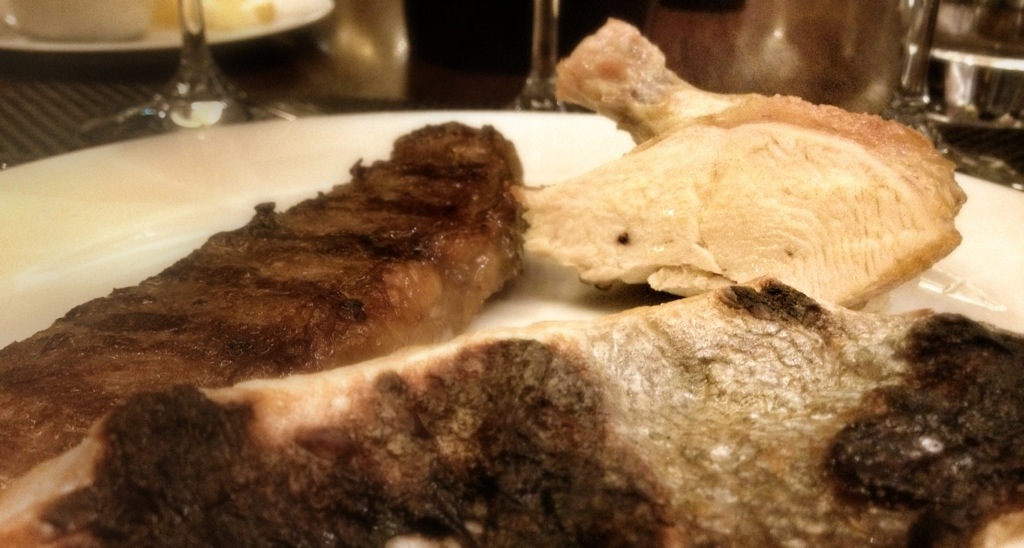
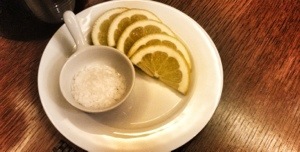
He’s also an original thinker when it comes to food and wine matching. And his original thought is this: don’t worry about the wine – just choose whatever you like – worry about the food. If the food has been properly prepared – specifically, if salt and acid are in some degree of equilibrium – your wine will taste just fine. It will taste like it’s supposed to taste, and that’s the main thing. He proved this to me once, by serving me a load of totally unseasoned food (that’s it above) and making me drink wine with it, and watching my displeasure. And then by encouraging me to squeeze lemon and sprinkle salt upon the food (that’s it below), and making me drink wine again, and smiling knowingly at my sudden enthusiastic nodding. Red wine and fish; white wine and steak – it’s all good. So long as you choose the wine you want to drink, and the food you want to eat, happiness iguaranteed. “Choose the wine you like, taste it, taste your food, and if it doesn’t taste right, add lemon and salt, and the wine will taste the way it’s supposed to,” he says. “It’s that simple.”

20130327-212647.jpgIt’s a beautifully straightforward philosophy, and with plates of food based round slabs of protein I’m convinced that it works. It won’t turn sauvignon blanc into the best possible match for a rare T-bone steak, but if what you want with your T-bone is sauvignon blanc it will allow both beef and booze to taste as they should, and leave you free to do lots of unselfconscious grinning. It’s less handy when it comes to pudding, which doesn’t tend to benefit from the heavy-handed addition of salt, but then again salt is only sodium chloride, not magic fairy pixie dust.

So burn your food-and-wine-matching bibles, all you need at your table is some salt, some citrus and an open mind. Drink what makes you happy, eat what makes you happy, be happy. Nothing could be simpler.

Mother’s Day Moscato

20130314-133803.jpg

There are books and websites entirely devoted to food and wine matching. People spend a lot of time on it. Not me. I think that, confused by the amount that people they consider more knowledgeable than themselves bang on about it, many wine drinkers find the subject enormously offputting, and that some of them are put off wine, or at least the full appreciation of it, as a result. A few very basic rules are all you need, and everything else will look after itself. Rule No1, and most important by a margin: Drink the wine you like, with the food you like.

But that’s not to say that perfection doesn’t exist – just that there are many practical issues that make it unlikely that you’ll get there very often. For a start, you don’t know precisely how a dish will taste until you’ve cooked it, or how a wine will taste until you’ve opened it. And by then, if the match isn’t quite right, you’ve still got an open bottle of wine and a plate of food. You’re not really going to throw either of them out, are you? But if it’s the wine you want to drink, you’ll probably have a good time anyway – even if it goes so very badly with the food that you leave it until after your meal to actually drink it. If you only opened it because of something you read on matchfoodandwinelikeapro.com, you’ll only have to go back to the wine rack for something you want to drink.

All of which is a long-winded way of leading up to this revelation: last Sunday, Mother’s Day, I cooked my mum blueberry pancakes and served them for brunch with Innocent Bystander’s delicious, delicate, berry-blessed and just 5.5% pink moscato, and it made me very popular indeed. I’m not always convinced by the pairing of very sweet food with very sweet wine, but this put not-overly-sweet food together with not-entirely-cloying wine, and it was very jolly indeed. The wine is widely available, for around £6-£6.50, so if you’re cooking anything berryish, try it. If you fancy. Or don’t. Obviously.

I’ll have more about food and wine matching, incidentally, very soon (when I finally get round to pressing the publish button on the world’s all-time most overdue blogpost).

Codorniu take Cava back to the future

Codorniu winemaker Bruno Colomer Martí

After nearly 45 minutes spent in the genial company of Bruno Colomer Marti, head winemaker at Codorniu, I ask him about the situation in Spain and his eyes turn downwards. “You know that in Spain we have a big problem with politicians,” he says (he actually says “politic men” rather than “politicians”, his English being just 90% perfect). “We have 25% of people without work – 50% for young people. They start to work at 30. It’s terrible. And now we have the crisis. For us, it’s OK. The number of bottles [we sell] is more or less the same, but with low quality. They spend less money. But we are very happy that we are the most important Cava house, with the biggest market share. We are sure that when the crisis disappears, that will be perfect for us. For us, now is a difficult time. We are not happy.”

Even before Spain was engulfed in financial crisis, Cava exports were expanding faster than a glutton’s waistline. In 1982 they packed off 18 million bottles; in 1989 48 million; in 1996 nearly 61 million; in 2002 108 million; and by 2007, when the financial crisis hit, the best part of 127 million. In percentage terms, in the last 30 years exports have increased from 18% of production to 60%. But with Spanish sales slumping producers need global thirst for their bubbles to boom still further, which means that us British Cava-drinkers are getting a fair bit of extra attention.

By volume Codorniu is the third biggest sparkling wine producer in the UK market (Freixenet, who with Codorniu produce about 90% of all Cava, and Martini Asti, since you ask), but even their popularity here comes with a downside. Brits like Codorniu, and Cava in general, because it’s reliable, fizzy and cheap. Try to sell expensive Cava, though, and we go off it pretty rapidly. Which is why Reina Maria Cristina, the best of their widely available wines, a 100% pinot noir white sparkler produced only in good vintages, is discounted here to £10 a bottle, when a Spaniard would expect to pay about £15 (and that even though £2.91 of our bottle price is either duty or VAT on that duty, and the Spanish get theirs all-but tax-free) . It has also led the marketeers to develop special baby blue and bubblegum pink bottle wraps just for us, the better to catch the consumer’s eye or, as the company’s PR representative puts it, “premiumise”.

20130305-075835.jpgGiven the amount they can charge for it, the effort of putting bubbles into the wine scarcely seems worth it. It’s just a very expensive and laborious way of making their grape juice less valuable. It seems they’ve worked this out too, having just launched their first still wines into the UK market (well, their first since Jose Raventos brought bubbles back from Champagne in 1872). The wines, an albarino-chardonnay white and a cabernet sauvignon-tempranillo red (made by the Australian Mark Nairn, while Colomer Marti concentrates on the Cava) are both decidedly decent, food-friendly quaffers destined to be discounted down to £6.99, and available from Ocado.

For a company that has been in the hands of the same family since 1551 – “I was in New York last week,” Colomer Marti says at one point. “When we started making wine, New York didn’t even exist!” – Codorniu are surprisingly keen on growth and innovation. “We want to bring more consumers into the Codorniu brand,” the PR person tells me. “We have a very loyal following, and Spanish wines are doing phenomenally well at the moment, but there aren’t many brands in the Spanish wine market. It’s our idea to bring something new. We know people like the reassurance of brands. We’ve done a lot of consumer research, asking whether people accept the Cordoniu brand for still wine as well as sparkling, and people think they’ve bought it already. They’ve seen the label, they think it’s familiar.”

It’s hard to be genuinely happy about a situation that has been brought about by the combination of one country’s economic armageddon and another’s collective refusal to spend appropriate sums for decent wine, but that’s where we are. The upshot is that in the British market, all of Codorniu’s Cavas except perhaps the basic Brut are cheaper than they should be, some by quite a way. The Seleccion Raventos, currently £7.49 at Majestic, and the Reina Maria Cristina, which is £60 for six at Tesco, are the ones to go for. Codorniu’s wines may be losing their fizz but at prices like that their sales figures shouldn’t.