Category Archives: Uncategorized

Who sells whose wine?

I made (what I thought was) an interesting statistical discovery while cruising the internet yesterday. Wine-searcher.com is intended primarily as a place where consumers can search for which retailers are offering a specific wine, and how much they are offering it for. It costs a smallish amount ($39) a year to get the full service; I’ve been subscribing for the last couple of years and find it extremely useful. But it does other things as well.

In order to tell you who’s selling a wine, they need to store every retailer’s entire catalogue. At some point recently they’ve started displaying breakdowns of what makes up these catalogues. Clearly a retailer’s spirits are included alongside the wines in these statistics (either that or Scotland makes more wine than I realised), and probably their beers as well (Belgium and Holland crop up on Sainsbury’s list). I found them quite interesting, especially when comparing retailers, so here are a few highlights. (I know the text in the graphics is pretty small – if you click on them they’ll open in their own window and will hopefully be big enough to read)

You might expect, for example, Asda, Tesco and Sainsbury’s to offer a fairly similar selection, but you’d be wrong. Every standard major English retailer sells more wine from France than from any other country, but at Asda the USA are hot on their heals – French wine makes up 12.64% of their offering, American 12.48% – and at Tesco Australia isn’t far behind (23.79% to 20.7%). The USA’s popularity at Asda isn’t reflected elsewhere – they provide 3.81% of Tesco’s wines, 6.58% at Sainsbury’s and 4.79% at Waitrose. Chile is the fifth biggest producer on Tesco’s list, but seventh at Asda and Waitrose and a miserable 13th at Sainsbury’s. I thought Argentina’s malbecs were big sellers, but in fact they’re an “other” everywhere except Majestic (3.06%) and Tesco (1.44%), which at Sainbury’s means they’re below Belgium, Sweden, Holland and Mexico.

Aldi, the discount supermarket chain, is a curiosity: here France limps in joint fourth, behind South Africa, Chile and Italy, and level with Australia, Germany and Hungary. Spain, with 4.76% of their list, are precisely half as popular. As you might guess by those slightly weird numbers, their list is pitifully small with just 63 things on it.

The higher you go up the qualitative scale, the more France dominates – by the time you hit Berry Brothers the French are responsible for a stonking 76.04%. And there are still some surprises: New Zealand is Majestic’s No2 producer, but No9 at the Wine Society and at BBR it’s just an “other”.

But I guess the most notable thing is the number of different countries whose wines British merchants list. Here, by way of comparison, are a few foreign retailers. Wine.com, apparently America’s largest online wine distributor, does pretty well (though American online wine retailing is a complicated thing, and I couldn’t find any of the major supermarkets, so I don’t know how representative it actually is), but wine lists in Australia and France look very different to ours, and a lot less exciting.

A few Aldi options for the Christmas table

At the start of this year, someone at Aldi offered to send me a selection of their wines. Sure, I said. But when a full dozen arrived, it was clear that if I was to taste them alone a large amount of wine would end up going down the sink – and even if none of them was ever likely to be my wine of the year, this is not a welcome prospect. So I invited round a load of friends and we went through them together. Here is some proof:

We had a lovely evening. With all wines served in similar newspaper-based disguises, and with a couple of non-Aldi ringers thrown in to keep everyone on their toes, everyone tried everything before choosing their top three and bottom three. Consensus was nowhere to be seen, with every single wine featuring among somebody’s favourites and somebody else’s rejects.

It was going to be a brilliant blogpost. One of the best. But then, in an incident which has come to be known as the Great Note-Disappearing Scandal of 2011, everything I had written on the night was lost, and with it, any chance of the blogpost ever being published. It was my lowest hour, a personal humiliation.

Then a couple of weeks ago, someone at Aldi, a new person, offered to send me a selection of their wines. I told the new person about the Great Note-Disappearing Scandal, and they forgave me. Though he may have born it in mind when he decided to send me just five bottles this time. Well, if that’s the case we’ve both learned our lesson, because this is what I thought of (three of) them, opened without friends, and without delay:

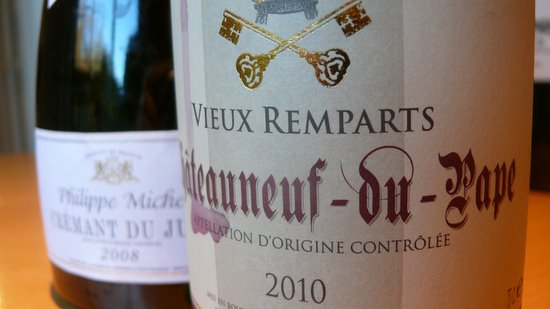
Philippe Michel Crémant du Jura Sparkling Chardonnay (£6.99)
This is the bargain of their range, in the shops all year round a hit both times I’ve tried it. A bone dry sparkler that’s lovely on its own and clean and gentle enough to work well as a base for cocktails. The bubbles aren’t enormously persistent, but it’s unlikely to matter that the wine goes flat in five minutes when glasses will be empty in three. Even the half-price Champagne that swills around supermarket aisles at this time of year looks pricey by comparison. I’d be very happy to make this my official house sparkler of the 2011 festive season (had I not already stocked up with this).

Vieux Remparts Chateauneuf-du-Pape 2010 (£9.99)
This would make a decent gift, because it comes in a nice bottle with some embossed bits and was crafted in one of France’s most famous winegrowing areas. But the bottle and the label are costing a good few pounds here – this is a nice, soft, gluggable grenache, low in acid and tannin, of the sort that you can pick up in most good retailers (from a less sought-after region) for around £6.99. It’s only distantly related to the famous Chateauneuf domaines, just as cut-price supermarket champers is a very distant cousin of Pol Roger. Still, when Tesco’s Chateauneuf is over £15 and Sainsbury’s a penny less – and both those bottles, in the Finest and Taste the Difference range respectively, come covered in supermarket branding and are thus considerably less appropriate as gifts – I guess this must be seen as something of a bargain. This went on sale on Monday, and is out there while stocks last.

Maynards Late Bottled Vintage Port, 2007 (£8.99)
Proper vintage port is still scarily expensive, but every other variation on the theme is puzzlingly cheap. This is good stuff, with a pronounced pong of leather and tar and chocolate and blackberry and kirsch – my little glass made an entire room smell of festive celebration – and deep, rich, warming flavours of cooked berries and plums and chocolate and spice.  It’s lovely, and (while pretty much the going rate for LBV) a great bargain, and I can absolutely see it trotting off down the aisle with a truckle of Stilton at the earliest opportunity (like most wines with a bit of sweetness to them, I find it’s better with salty food than sweet). Highly enjoyable, this also went on sale on Monday and is there while stocks last.

Centum Vitis: the perfect Christmas present for the wine-lover who has everything (except taste)

The bottle Cono Sur use for their 20 Barrels pinot noir reminded me of one wine I tried while I was in Rioja. The world of wine is all about indulgence and frequently creeps over into excess, but here was the most indulgent, excessive thing I have ever encountered.

The wine is created by Bodegas Valdelana, using fruit from a pre-phylloxera vineyard. The vines are proper old, and produce so incredibly amazing they decided that the only way to treat them with due deference would be to vinify them and package them in the most incredibly amazing way they could think of. If they could only have aged it in barrels made from the tree of knowledge, bottled it in vessels hand-blown by genuine leprechauns and labelled it with signage individually crafted by angels, before finally distributing it to their grateful consumers on unicorn-drawn chariots, they surely would have done. Instead they bought the heaviest bottle known to man – 3kg when empty, our guide proudly told us – designed a metal label, packaged it with a pot of genuine gold leaf (you’re supposed to sprinkle it in your wine for extra health-giving anti-oxidants) and slapped on a $250-a-bottle price tag.

The resulting wine, apparently best drunk within two years, is sold in luxury establishments such as the Burj Al Arab hotel in Dubai, and in exclusive American retailers at $250 a pop. The wine is OK, and would represent decent value if sold gold-free at 10% of that price. As it stands, it’s the perfect gift for the man who has everything (except taste), or Olympic weightlifters in search of a fresh challenge.

Valdelana’s little old bodega is a funny old place to visit, by the way, complete as it is with lots of fake grass and a subterranean mirrored “vineyard”. The best thing about it is the view from the door down the road to Marqués de Riscal, the brilliant Frank Gehry-designed hotel-on-top-of-a-winery, about which more, another time.

He ain’t heavy, he’s my Cono Sur pinot noir

Question: Above are two Cono Sur wines, the standard pinot noir – commonly known, for obvious reasons, as “bicycle”, and the triple-the-price 20 Barrels pinot noir. What’s the main difference between them?

Answer: Nearly half a kilogram.

The 20 Barrels isn’t even Cono Sur’s premium pinot, that honour going to the presumably heavier still Ocio. I must say I’m puzzled that wineries feel the need to waste money and energy on buying and shipping hefty bottles to denote higher quality contents, when the price tag attached to the wine will do the same job just as well (and would be a bit smaller without them). The difference on this occasion was, to be precise, 444g – a full bottle of the Bicycle pinot weighs in at 1.192kg, its big brother at 1.636kg. Cono Sur is otherwise pretty eco-friendly as absolutely massive winemaking behemoths go, so much so that some of their vineyards are kept weed- and pest-free through the winter by flocks of marauding geese. The choice of emblem for their basic pinot, the bicycle, “symbolises our spirit of innovation, passion, commitment and respect for the environment,” they say. They could do a little bit better.

But when it comes to the contents of the bottles, what is the difference? Let’s look at the back labels for a clue.  Hmmm, the Bicycle has “flavours of cherry, plum and strawberry”, and the 20 Barrels offers “notes of fresh cherry, strawberry and plum”.  Er…

I like Cono Sur’s pinot noir, probably the only sub-£6 pinot I’ve ever bought more than once, and generally a pretty reliable supermarket buy. It’s currently reduced from £7.49 to £5.99 at Tesco (until January 3), or £6.79 at Sainsbury’s, where it’s not on promotion. It’s not enormously complex, but offers loads of fresh, yes, cherry and strawberry fruit and a great deal of pleasure for the money. For £5.99, frankly, I wouldn’t hesitate.*

The 20 Barrels, at £19.99 from Morrisons or Waitrose, is obviously in a totally different price bracket. Where much of the Bicycle’s fruit is machine harvested and just a fraction – 35% to be precise – spends six months in oak (the rest hanging out in stainless steel tanks), all of the 20 Barrels wine relaxes in barrels for an entire year. The result is more spiciness, with cinnamon and smoke coming through, and riper, darker fruit. Though the 2008 I tried wasn’t terribly old – just a year older than the Bicycle, and bottled a mere five months earlier – it looked a lot older than I’d have expected, browning at the rim. This was a bit surprising in what’s still a pretty young wine, but gave it quite attractive maturity that’s rare in an off-the-shelf wine and makes it without reservation ready to drink right now. It beats the Bicycle on every measure other than value: it’s good stuff, but in the £20 a bottle range it does have a lot of other good stuff to compete with.

* On the subject of wines I wouldn’t hestitate to buy, Tesco’s online wine-selling arm are currently knocking off Penfolds Bin 28 Kalimna Shiraz for £6.64 a bottle here. If you’re quick, you can use the code XXHHN4 to bring that price down to £5.85 a bottle, after delivery charges. It’s a big, bold, ripe Australian belter, based on Barossa fruit, and the 2008 – which should be what you get – is reckoned to be one of the best vintages in yonks. To illustrate how good a price that is, it’s also on offer at Majestic, where the offer price is £10.99, down from a standard £13.99. Wine Rack and Avery’s both list it at £13.99. Buy it and drink it over the next 30 years – it’s got a reputation for standing the test of time.

Coq and Cruz

I’ve had the very great pleasure and privilege of attending a few interesting dinners in recent weeks, one of which even tiptoed towards greatness, while another edged uncomfortably towards the other end of the qualitative scale before rescuing itself heroically.

The former was at Coq d’Argent, a fairly fancy restaurant which caters for city types, situated as it is close to the Bank of England on Poultry, among the best-named streets in London and inspiration for the first half of the restaurant’s name. So far as I can see, the only possible complaint about this place is the prices – mains start at £19 and trundle gently upwards towards an offputting £34, though there’s a seven-course menu dégustation (which counts sorbet and pre-dessert as courses in their own right, and thus is really a five-course tasting menu with bonuses) which looks like something of a bargain at £48. Some of the food we ate was exceptional – a fillet of beef with sauteed wild mushrooms, truffle and pan fried foie gras was possibly the best dish I’ve been served this year – and some of the wine stonkingly delicious.
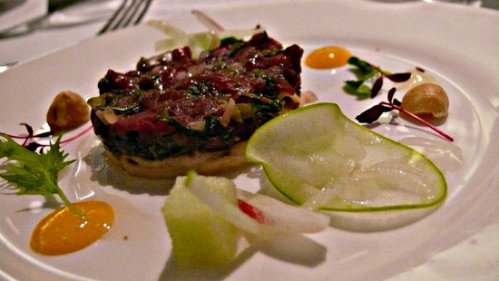
Venison tartare on celeriac and hazelnut remoulade with pickled apple compote. Don't you know

We’d been brought there to investigate the restaurant’s enomatic machine, which allows them to serve some seriously fine wine by the glass. It doesn’t make these wines cheap – from their current selections a 175ml glass of wine, which the pub chain Wetherspoon’s would define as “small”, costs between £19.50 and £45.50 – but it does make them vaguely achievable. I’d love to try Chateau d’Yquem, but given that Le Coq sells bottles for anything between £215 (for the 2003) and £7,000 – that’s seven thousand pounds – (for the 1921), and the cheapest I can find it anywhere else is £94.95 for half a bottle, I’m not about to do it any time soon. If it were in the enomatic machine I’d probably still blanche at the price of a full glass, but I would be able to try a 25ml sip for less than a tenner.

Machine aside the wine list, compiled by Olivier Marie, their head somelier of 10 years’ standing, is good enough to have been named the best in the country earlier this year. It’s quite long, and I’m sure it would absolutely terrify a novice, but there are some interesting wine facts scattered among the pages, some low mark-ups on the top-end wines, and even if you know your wine you’re probably best off just asking Olivier what you should get anyway.

The man knows his stuff. Before the dinner I was told that I’d be trying some very big names – Yquem, for a start. They never came, but then anyone can say that Yquem is likely to be a decent wine; Marie thought a 1989 Philippe Foreau Vouvray moelleux would be better with our dessert, and it was utterly splendid. With that beef fillet Marie proposed a 1995 Chateau Troplong Mondot (available online for £81 a bottle; on the wine list for £179); Tom Harrow, aka the Wine Chap, who was co-hosting the dinner, quite fancied a 1996 Chateau Montrose (available online for £133 a bottle; on the wine list for £185) instead. In the end we got both, but the St Emilion was by far the better match (I didn’t get on that well with the Montrose, which had an overwhelming and one-dimensional aroma of pencil-shavings). The vouvray was probably my wine of the night, though a 2005 pinot gris Cuvee Laurence from Domaine Weinbach (available by the case online for £29 a bottle; on the wine list for £83 a bottle) was another stunner, and with its zingy acidity and raisined but gentle sweetness made a brilliant match for foie gras terrine.

Le Coq d’Argent is in the city, and is always likely to have lots of suited bankers filling its tables. It comes at a price which only the extravagantly bonused might consider inexpensive, but they offer some of the best non-Michelin-starred cookery in the land, and a great wine list. In addition to the enomatic machine they have a small selection of themed two-glass wine flights – it’s that kind of stuff which makes drinking wine in restaurants, for all their often galling mark-ups, worth doing. I recommend it heartily, if you’re in the area and feel a bit flush. You can read my fellow diner Tara Devon O’Leary more forensic account of the meal here, if you wish.

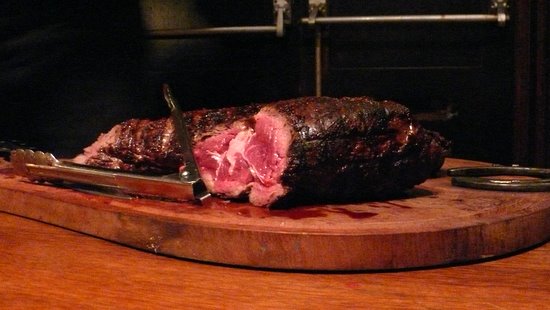
On, then, to a very different meal at Clerkenwell’s Argentinian restaurant A La Cruz. Among the worst possible destinations for a first date with a vegetarian, this place is all about its asador, a charcoal pit over which meat slowly roasts. They take this so seriously they ship the wood over from Argentina, because nothing we’ve got does the job quite so well. The side dishes we got with our meat – a few sad potatoes; a couple of lettuce leaves and a large pile of red onion – suggests that protein is the priority here. We got lots of it; first we shared an entire beef fillet and a rib-eye, the latter by the chef’s own admission rather undercooked. What’s more, the chef’s portioning was so out of kilter that several people still hadn’t been served by the time the fillet was finished, and had to hang around for a while until someone seared them a steak. On the plus side, this meant that everyone got a very generous portion of meat. And then, when we had finished that, we shared an entire lamb. This little beast had been cooked long and slow on the asador, in the manner any visitor to Patagonia might have witnessed, and the results were sweet and tender. Anyone with a love of the dramatic and enough like-minded friends to stage a large-scale meat blow-out could do a lot worse than pre-order their cordero entero.

They make a very good chimichurri, which is something we don’t see often enough, and the meat is obviously of a very high standard (though to my mind it could have been a bit more liberally seasoned). A La Cruz has impeccable heritage, sharing an owner with Broadway Market’s excellent Buen Ayre, and makes a very good place for a meaty blow-out, though still a rung or two below Hawksmoor standards. I used to work a couple of minutes’ walk from here, and saw a couple of restaurants open on this site only to close soon afterwards. It’s a difficult location, very close to trendy Exmouth Market but far enough away for nobody to actually walk past very often. Let’s hope this one, which was pretty full on the weeknight I visited, bucks the site’s unhappy trend.
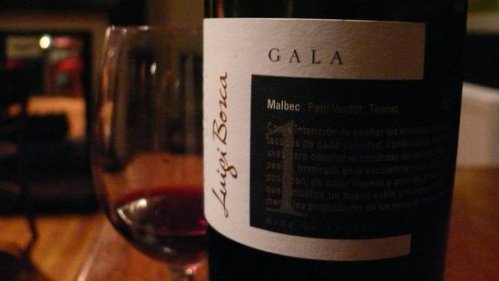
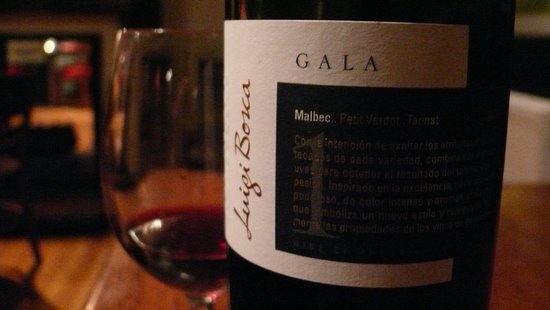
We drank, incidentally (and everything but the meat was incidental), a couple of wines from Luigi Bosca. His Gala 2, a Bordeaux blend of cabernet sauvignon, cabernet franc and merlot, was big, smooth and ripe-fruited to an almost unpleasant degree, although some people will love it. Gala 1, a blend of malbec, petit verdot and tannat, was considerably superior, for the same price.

Anyway, enough about posh stuff. My next post, comin’ atcha later this week, is about Cono Sur pinot noir.

White Lions (do do it)

North London is a bit of a vinous backwater. I moved out of Archway within months of the Theatre of Wine arriving to bring the area its first really good wine shop, and my new neighbourhood, East Finchley, has nothing to rival it, not even close. There’s a branch of Majestic halfway to Muswell Hill, and after that, nothing. Even the posh parts of north London don’t have much to shout about – a branch of Jeroboams in Hampstead; a shop called Bottle & Basket in Highgate village which remains defiantly unwebsited, while Kentish Town, Belsize Park, Golders Green and Hampstead Garden Suburb boast nothing more than the occasional branch of Nicolas or Threshers. It’s more or less a dead zone.

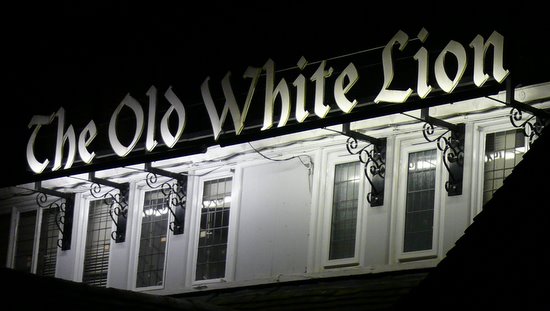
So in the circumstances I was delighted to find signs of life in the Old White Lion, a humble pub next to East Finchley tube station who have taken to putting on wine tastings at absolutely no cost for regular customers and interested others. Each session has a theme – this Thursday’s, the last one before Christmas, is focused on fizz, but the one I went to was all about the “classics”.

What this amounted to was six wines from classic old world regions – a Sancerre, a Chablis, a Bourgogne rouge, a Chianti, a Bordeaux and a Rioja – all of which were on the pub’s list. The tasting was led by a bloke from Liberty, importers of some very excellent wine, who did his job pretty well, knowledgeable enough to inform but still very much open to beginners’ opinions. The wines weren’t enormously exciting, but they were by and large decent representatives of their areas (though if I came from Burgundy I might have been a bit upset). The result was some interesting discussion on each of the two tables, and some people more engaged with wine and its variety of styles than they were before.

I’ve been privileged to go to some pretty memorable wine tastings in recent months, but in many ways this was the best of all. Because if the Old White Lion can enthuse my fellow East Finchleyites about the pleasures of the fermented grape, maybe one day we’ll finally get a decent wine shop of our own.

And if you’re in the Old White Lion sometime and you fancy some wine, I’d recommend the Chianti. Soft, round, fruity and uncomplicated, it’ll go down well in any social occasion and at £18 a bottle it’s decently priced too.

The problems with Rioja – 267 million litres sold last year and they’re still not happy

I’m just back from a three-day trip to Rioja, another eye-opening experience. It’s interesting how miserable everyone there is about the Spanish wine market – I’m afraid I’m going to have to use quite a lot of numbers to tell you about it. Although Rioja utterly dominates the Spanish wine scene, producing near enough 39% of every drop drunk in the country (their closest challenger, Ribero del Duero, musters a mere 8.9%), everyone seems very worried about their future. A decade ago their statistical dominance was even more impressive: back then Rioja produced 70% of all the wine sold in bars, cafes and restaurants; last year that was down to 52.2% “Nobody drinks wine any more,” one producer told me, and though this isn’t entirely true the numbers are certainly heading down – in the first seven months of this year the Spanish wine market dropped by 5.1% by volume, and 4.7% by value (and 2010 was hardly a classic year, having seen drops of 0.9% and a ghastly 7.7% by volume and value respectively, year on year).

In particular, sales of white and rose wines from the area are collapsing. Muga’s rosado, the wine whose massive popularity within Spain put the family on the viticultural map, according to the current winemaker Jorge Muga, is now totally shunned, and 90% of it is exported. Particularly bizarre as it’s bright, crisp and very cheap – around €5 over there, and about £8 here (find it at Waitrose, The Wine Society and independents). Rioja Riservas are so untrendy that many winemakers only label them as such for the export market, and try to disguise them as more fashionable crianzas within Spain.

In the circumstances it might seem sensible to put a bit of money into trying to change public opinion in Spain. Instead, with the local economy in crisis and the unemployment rate hitting 21.5%, they have given up on the Spaniards and will concentrate on convincing the rest of the world to buy all the stuff that’s now failing to sell to the locals. This has worked of late – in 2010, for example, while Spaniards turned their noses up at Rioja Reservas, their sales in the UK rocketed by 56%. But the US has been identified as “the market with the greatest growth potential”, having grown by 30% last year to leap from No5 to No3 in the list of the world’s top Rioja importers (now behind just league-leading Britain and Germany), and 36% of the region’s publicity budget will be spent there this year.

For all the misery, global sales of Rioja were up 13% in 2010, an increase of 31 million litres. They sold, in total, 267,117,831 litres of the stuff. That’s a lot of wine, and more than 100,000,000 litres more than they sold a decade earlier, which in turn was nearly 60,000,000 litres more than they sold in 1990. That kind of growth can’t continue forever.

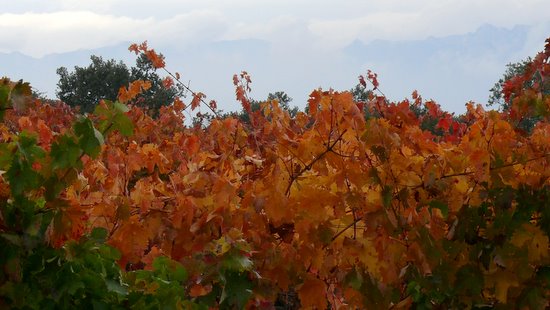
I’ll post more about my trip in due course. The picture at the top shows the view from the winery at La Emperatriz, interesting mostly because it shows the colour variation between the leaves of the region’s key grape varieties in the autumn. The rusty brown-red that dominates the scene and makes the area so dramatic at this time of year is tempranillo (more of which above), the patches of light green top left and far right are viura, Rioja’s key white grape, and the darker green bit is garnacha. I’m actually not entirely sure what the darker red bit is, but by process of elimination I suppose it can only be graciano (they don’t grow any mazuelo, or any other white grapes).

Introducing: The beast

Introducing the latest answer to the question: “Shit, so where do we put all of those, then?”

Really, the house move forced it on me. In the old house we had built a cupboard in the coldest part of the basement specifically to contain a big wine rack, and shunted some more wine, still in boxes, under the stairs. This was all perfect – largely stable temperatures, no light, largely undisturbed. The new house, though, only had one potentially suitable place and the only way to access it was through its own outside door. In other words, to get a bottle of wine I’d have to actually leave my house. This, clearly, was unworkable, particularly in the rain (and also, more worryingly, it was evidence of an idiotic architect having had a hand in our new house at some point).

Several weeks spent monitoring second-hand and auction sites later, I had myself a wine fridge. A couple of weeks waiting for someone to come and fix it because obviously it was broken when it turned up later, I had myself a functioning wine fridge. A couple of weeks waiting for a free half-day in which to sort it all out later, I had myself a functioning wine fridge full of wine.

I had no idea, before I loaded up the fridge, precisely how much wine I had accumulated (answer: too much). Nor did I really appreciate how lopsided my collection is (though I knew that winemakers in or inspired by the Rhone valley would have produced most of it). For what it’s worth, the shelves in my wine fridge are currently allocated as follows:*

  • Spanish & Portuguese reds
  • Italian reds
  • Southern Rhone red blends (not all from the Rhone)
  • Northern Rhone reds
  • Australian and Kiwi Shiraz, syrah and shiraz/viognier
  • Bordeaux blends (not all from Bordeaux)
  • Pinot Noir
  • Musar
  • Reds for guilt-free drinking
  • Dry, steely whites
  • Aromatic whites (quite a few of these also from the Rhone)
  • Annoyingly large bottles (mainly also white, some from the Rhone)

But it’s clear that there’s one kind of wine I’ve not got enough of: the kind that costs less than a tenner a bottle. I’m already planning to remedy that situation – just as soon as there’s room.

* Cellartracker informs me that, including wine that is sitting around elsewhere waiting for the day I decide to get it delivered, 81% of everything I own is red. My favourite countries, in order of ownership: France, Italy, Australia, New Zealand, Spain, South Africa, Argentina, Lebanon.


Lawyers and logos

The old Cellar Fella masthead

The Craggy Range logo

Yesterday I was asked by someone at Kiwi dream-snatchers and winemakers extraordinaire Craggy Range to remove my masthead and change my logo. I think this is a bit sad, for several reasons. 1) it took me ages to do on Photoshop, because I’m not very good at Photoshop; 2) I like it; 3) I also like the wines of Craggy Range, and the part of the world where they’re made; 4) I really didn’t see what impact my logo, for all that it did fairly closely resemble theirs, could possibly have on them. They looked alike, but very far from identical; 5) I couldn’t possibly say no. I had, after all, plagiarised their graphic design work, and without asking their permission or anything.

Worst of all, the email arrived in the middle of dinner. “Whilst imitation is the greatest form of flattery the adapted use of our logo for your own uses is not really appropriate in our view,” they wrote. “Therefore I am asking that you change your logo to something that less resembles the Craggy Range logo.”

I duly spent several seconds thinking of another of my favourite wines that prominently features letters like C and F, and whose work I could pay tribute to in future, or at least as long as it takes for them to notice and tell me to stop. A couple of hours photoshopping later, and the new Cellar Fella masthead is ready, renewed, refreshed and rejuvenated, the Daniel Craig to the old one’s Pierce Brosnan. Enjoy. Unless you’re a lawyer, in which case there’s nothing to see here, please move on.

Feel free to leave your feedback on the new one, particularly when it comes to whether I should remove the hyphen, about which I am quite unsure.

WIN! A whole day spent drinking amazing wine for free!

Decanter have very kindly offered a ticket to their annual Fine Wine Encounter to one lucky CellarFella reader of my choosing. The ticket, for Sunday November 20th, will go to whoever offers me the most money gets my fabulous quiz question correct. But first, let me tell you a little bit about the event. It’s a contractual obligation.

You’ll have all day, or at least the part of it that falls between 11.30am and 4.30pm, to taste at your leisure over 600 wines crafted by the likes of Bordeaux big-hitters Cos d’Estournel, New Zealand-based logo-thieves Craggy Range (for legal reasons I should probably make clear that it was I who stole and defaced theirs), American legends Ridge, obscure Italian outfit who I visited once Ampeleia and Argentina’s Bodega Catena Zapata, all of them poured by the very people who crafted them. There are also ticketed wine tastings and masterclasses, though they cost extra and are filling up fast (and some of them have filled up already), book signings and much much more. It’s basically Disneyland for wine geeks.

It’s on Saturday 19 November and Sunday 20th, at London’s Landmark Hotel. Tickets, if you’re not lucky enough to get one free from me, start from £40 and shoot upwards in a way I find a bit confusing if I’m honest. Find out more about the event here.

The question:

There’ll be a whole room at the Fine Wine Encounter dedicated to the winners of this year’s Decanter awards. But where, according to Decanter’s judges, is the world’s best Bordeaux-style wine (costing over £10) grown?

Send your answer to me here. You’ve got a week, until 11.59pm GMT on Monday October 31. Good luck!