Category Archives: Uncategorized

Clean conscience, empty wine glass

A sight unlikely to be enjoyed chez CF any time soon

Most of the wine I buy costs less than £15 a bottle, often around half that amount, and comes either from local merchants or from a few online favourites. I often get two bottles of a wine – just to make sure I don’t accidentally catch it on a root day – but rarely more. There are, after all, a lot of nice wines in the world, and not a lot of time to drink them, so what’s the point of letting any one overstay its welcome? Wines are not women: I’m not searching for the one here; I’m more than happy to enjoy a succession of one-night stands and, perhaps, the occasional threesome.

But every now and then I’ll buy a whole case of something, if it looks particularly exciting and well-priced. One wine I’ve bought cases of twice is Coudoulet de Beaucastel, the bargain-basement illegitimate half-sister of Beaucastel’s Chateauneuf-du-Pape, which on its day is one of the finest wines on the planet (the Chateauneuf, not the Coudoulet – on its day the latter is vaguely redolent of one of the finest wines on the planet, which for the price isn’t bad going). But I’ve been repeatedly recommended the white version, and thus a couple of weeks back I found myself on wine-searcher seeing if you can find it at the kind of knock-off prices at which you can occasionally find the red (you can’t).

While doing so, I happened across a case of the grown-up Beaucastel Chateauneuf du Pape blanc, from an excellent vintage (2007), being sold for about the same price as the Coudoulet – in the region of £20 a bottle. This was significantly cheaper than any other merchant (though only by £50 in one case), and less than a third the price of some (Roberson’s, for example, sell the same wine for £75 a bottle). I felt they had almost certainly mistakenly labelled it a 12-bottle cases, when they meant six, but you never know – so I bought it. Someone from the merchant emailed to thank me for my order. I emailed back, to check that I had indeed bought 12 bottles. He replied to confirm that I had. They took my money and arranged a delivery. They failed to turn up once for no good reason, I had to rearrange, and this time they arrived four hours early – and with only six bottles of wine.

I’m no lawyer, but I was aware that by this point I had established a cast-iron, watertight contract. If I stamped my feet and hired a brief, they would have to provide me with 12 bottles of this wine. Or I could take the six at my door, and demand a hefty refund. But I also knew when I placed the order – even if they themselves did not – that they probably only meant to sell me six.

I refused delivery. They emailed to say that it had all been a terrible mistake, they only had six bottles, hadn’t meant to sell me them and refunded my money. My conscience is clean. But in all likelihood I will never now get to drink this wine, let alone six bottles of it, and I have been mourning its absence. A conscience is all very well, but it won’t quench your thirst, now will it?

So I’ve got no wine. For what it’s worth, though, I’d have expected at the very least a most humble apology, and probably some kind of voucher or something, to acknowledge that with their order-acceptance howler and their non-delivery howler they had in the end caused me significant inconvenience, without giving me any nice wine. Surely I can’t be blamed for buying their wine, and can be thanked for not being a git about their many errors. But they couldn’t be arsed. Goedhuis? Bad housekeeping, more like.

Hits and Mrs

Despite the amount of our money I spend on feeding my habit, Mrs CF has tended to be very supportive in my journey through the world of wine. She gets to benefit from it, of course: the more I know about wine the better the stuff I buy, and the better the stuff I buy the better the stuff she drinks.

So we have walked hand in hand along this road, generally enjoying the same things along the way. We have discovered together the joys of Loire chenin, and roussanne from the Rhone, and a succession of new favourites which would have been unfamiliar to both of us just a few years ago. If I occasionally buy something I don’t like, she tends not to like it either, and if I love something, she tends to like it quite a lot as well. That’s how it works.

And so I felt no particular concern when I poured her a glass of a new purchase I was excited about, Donnhoff’s Oberhauser Leistenberg riesling kabinett, 2009. It had perfect pedigree: Helmut Donnhoff is one of Germany’s great winemakers, king of the Nahe, beloved of, well, everybody. This, one of his most basic wines from a good vintage, got 93 points from Neal Martin, 17 points from Jancis Robinson, and to my mind is the perfect way to start to a warm evening. It’s lush and sweetish, but with riesling’s classic freshness, acidity and grapefruity zing. And at just 9% alcohol, you’re not going to regret it in the morning (unless what you really want is just to get ratted, in which case you should probably be drinking vodka).

Mrs CF sniffed her glass. She looked at me suspiciously. She took a sip. “Urgh! It’s sweet!” she said, and demanded I open something else immediately.

I’m determined to continue exploring German wine, but it looks like I’ll be doing it on my own.

Champagne socialism

20120417-111915.jpg

Sometimes a drinker’s opinion of a wine is anything but objective. Occasionally it is proudly, defiantly, unapologetically subjective, and it would be a tragedy for wine if it were never thus. There are a million reasons to be predisposed to liking a wine: meeting the producer, visiting the vineyard; having previously tried it on a meaningful occasion; it having been awarded 99+ points by your favourite wine critic, it being a favourite of your beloved great-god-uncle Seamus; a pretty label; coincidentally being giddily happy for another reason entirely at the moment someone pours it into your glass.

Politics might be an unusual reason to like a wine, but it’s up there on the list of possibilities. In Champagne there are basically four kinds of producer: the small-scale grower, the larger owner-producer that hasn’t sold out to anyone yet, the enormous mega-firm, and the cooperative. However fabulous their products, I find it hard to emotionally connect with a brand owned by, say, LVMH, the global luxury goods conglomerate whose fizzy-wine portfolio includes Moët & Chandon, Dom Pérignon, Krug, Veuve Clicquot and Ruinart, and whose pockets are also stuffed with the likes of Chateau d’Yquem, Louis Vuitton, Givenchy, Bulgari and lots of other posh stuff. A wine lover’s feelings for Dom Perignon are like, say, a football fan’s feelings for Real Madrid: sure, they’re good, but they’re terribly hard to love. For the same reason, even though their fizz might not be in Krug’s class, I find it hard to dislike the small independents. But there’s something about the best cooperatives, about gifted growers coming together for their mutual benefit, that I really like. It happens a lot, especially in Europe, but it’s particularly pleasing to see this spirit of community shine in these most gilded vinous corridors.

Some of these co-ops have grown to become extremely big businesses. Nicolas Feuillatte is the world’s third most-consumed Champagne brand with around 10 million bottles produced each year, while Jacquart have grown from humble origins precisely 50 years ago to control 7% of the whole region, and shifted three million bottles of politically-correct fizz last year.

I recently met Jacquart’s astonishingly young and impressive winemaker Floriane Eznack. There are many emotions I feel when I meet someone whose job it is to taste wine for a living – jealousy being by some way the most common – but here I discovered a new one: pity. For the first time I tried vins clairs, the still wines from which the Champagnes are blended, and I can only conclude that the role she performs is no less than alchemy. The stuff she starts off with is crazily acidic and astringent, wine that you couldn’t give away without the addition of a bit of sugar and a lot of bubbles. She seemed almost apologetic to be forcing them upon us, but it was a fascinating insight. It’s not hard to see why she has to see a dentist at least once every six months.

Jacquart relies on 2,000 growers farming 2,400 hectares of vineyards, and from the sounds of things they exert limited control over them – much of the chardonnay in 2011, for example, was mishandled. “I think they were harvested too early,” Eznack said. “It’s hard to manage the growers.” Last year’s wines, she said, were “showing very weirdly” – “from one week to another they change”.

Whether we caught them on a good week or a bad one, I’ve no idea. We tried four vins clairs, three of them from the 2011 vintage, and if you had pointed a gun at me and ordered me to assemble a base wine that would shift a million bottles, my only option would have been to blub like a baby and beg for mercy.

From these unreliable, unpalatable base wines, all vinified individually, Eznack and her colleagues must decide which go in the top cuvees, which in the basic bottles, and which in the giant tank of reserve wine that will help to make the produce of future years sit with the house style. I’ve got frankly no idea how she does it. None. At all.

Fortunately, you can’t buy any of the vins clairs, and the stuff in the shops has already had magic transformation dust sprinkled over it. If you do a bit of shopping around (wine-searcher is, as always, your friend) you can find Jacquart Champagnes at extremely decent prices – less than £20 for the basic Brut Mosaique, about £25 for the award-laden, lilac-scented rose, and under £40 for the very fine Brut de Nominee. Which is as good an excuse as you’ll find to fill your glass and raise a toast to the original Champagne socialists.

The wine that spent three years on a roof, and other stories

As regular readers (Hi mum!) will know, I posted recently about explorations into unusual wines from the likes of India, Turkey and Japan – but this will almost certainly end up as No1 in my Wacky Wines of the Year top 10. It is called Nach Sieben, and it’s a a maderised pinot noir from Switzerland.

Switzerland makes some excellent pinot noir, but y0u’ll find very little of it on British wine lists. There’s a good reason for that: they drink it all themselves. In 2009 the Swiss exported just 2% of all the wine they produced (and they don’t produce that much in the first place), while for example Spain exported 30%. So you won’t find any Swiss wines on the lists of the Wine Society, or Berry Bros, or Waitrose. If you want to try some, you’ll have to rely on one of a tiny number of specialist retailers (try Howard Ripley), luck out on a restaurant wine list or get yourself invited to the Swiss embassy for dinner.

If you end up there, you’ll quite possibly be served something imported by the Swiss-and-Italian specialists For the Love of Wine, who discovered a single barrel of this “likörwein” on a buying trip and snapped up the lot. It’s fruit from the 2003 vintage, of which half spent three years in oak barrels while the other half spent three years in “big glass balloons” on the winery roof, before it was united to spend a further five years in a single barrique. I’m not much of a winemaker myself, what with living in Finchley and stuff, but the glass balloons on the roof business strikes me as being towards the extreme end of total wackiness. Anyway, it paid off – a seriously walnutty and very enjoyable curiosity that should retail at about £13.25.

If you’d prefer a more traditionally-styled pinot noir from an unusual location, may I suggest the Edoardo Miroglio 2009 from Bulgaria. Swig are currently selling the 2008 for £12.50, which I haven’t tried, but will presumably soon switch to the later vintage. You’d do very well to find better quality at this price range, but don’t try to save money by buying his cheaper Soli offering, which is much less good and only £2.50 less expensive.

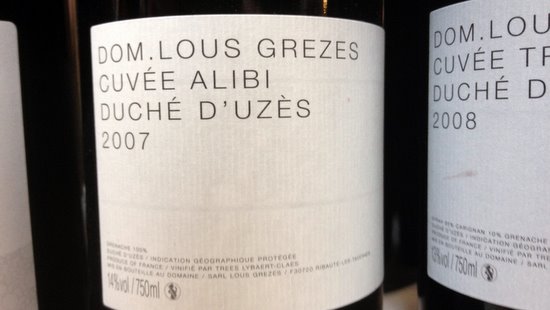
Both these wines were discovered at the recent, very busy and rather bewildering SITT (Specialist Importers Trade Tasting) event in London. Swig’s table carried impressively rich pickings, from which I’d also recommend the wild, almost port-like, yet fresh and insanely drinkable Domaine Lous Grezes “Cuvee Alibi” 2007 (they’re currently selling the 2006 for £21 and will put the price up by 50p when they move to the new vintage), 100% grenache released under the obscure Vin de Pays du Duché d’Uzès appellation, and the Michel Gassier Cotes du Rhone Cercius 2010, which is a fabulous, hedonistic taste explosion. The Americans got 5,000 cases – it’s all over the internet stateside at about $12.99 – and from the looks of things (it’s still unavailable here) we haven’t been left with much. Not yet on sale, and due to cost £13.95 when it does, it’s well worth a try. Nice label too.

And, for the record, my mum never reads my blog.

Lot 18: Not a lot to like (yet)

**NB on Tuesday 13 March this post was updated with two new and considerably more positive paragraphs at the end**

Last week, a(nother) new wine retailer launched in the UK, this one an online-only venture called Lot 18. They’ve got an intriguing proposition that looks to have some potential, not that it’s showing it yet.

Lot 18 launched in America in November 2010, and has been fairly successful there. But America is a winemaking country, and there they mainly offer direct sales – the winery makes the wine, Lot 18 sells it and the winery ships it. Here it looks like they will operate, at least for now, more like a normal wine retailer, albeit a retailer with a tiny selection of overpriced wine.

Let’s deal with some positives first. The site looks good – you’ll have to register before you’re allowed to have a good look around, but registration is free and easy – and each wine gets a chunky and lively write-up which is far superior to the two-sentence tasting notes common elsewhere. Chateau Grand Village 2007, one of the more basic wines of their initial offer, got more than 500 words where a typical description on The Wine Society’s website runs to about 40. This kind of attention to detail is the great benefit of having a relatively modest selection. They are also quite proud of their photography, and each bottle of wine gets a gallery of lovingly-shot profiles from a variety of angles.

So it’s a decent site to look around, but why should you get actually buy from Lot 18? Good question. I’ve got no idea. It won’t be because of their extensive range: they will only have between six and ten wines available at any given time. it won’t be because they specialise on one winemaking area of interest – the eight wines on sale at launch came from six different countries. And it won’t be because of price, either: their wines will cost between £10 and £90 a bottle, so they’re not going to attract the three-for-a-tenner crowd, but they don’t seem to be doing what’s necessary to attract the more discerning, fat-walleted wine-lover either. They’re not promising to be the cheapest on the market, which is fine – there’s more to life than the search for bargains – but there’s a difference between “not the cheapest” and “a total rip-off”.

Though Lot 18 will not be listed on wine-searcher, most people who buy wine at these prices will probably use it, and they won’t like what they find. Lot 18’s launch wines are either otherwise unavailable in the UK (so impossible to check on a like-for-like basis), or more expensive than elsewhere – in one case more than £30 a bottle more expensive.

I wrote an extensive wine-by-wine cost analysis, only to find out that Fiona Beckett’s piece, published on The Guardian’s website yesterday, covered pretty much exactly the same ground. Suffice to say that each of their wines come with two prices, one supposedly representing the market rate and another their discounted bargain price, but their sale price was never particularly competitive, and the so-called “retail price” seemed a work of wild invention. Lot 18 say that “our aim is to give our members access to wines in the knowledge that they will represent the highest quality and value”, but they seem at best to be delivering on only half of these two criteria.

I don’t want to be mean about Lot 18. Far from it: their UK team took me out to dinner last week, the night before their site went live, and seemed a lovely, enthusiastic, fairly posh bunch (Will Armitage, their general manager (Europe), owns seven racehorses). They gave me some very nice wines, of which one is already on sale – Inglenook Rubicon Estate Blancaneaux 2009, a Rhone-style white blend from Francis Ford Coppola’s winery – which isn’t otherwise available in the UK but they’ve priced at a fairly ambitious £85 for two (though it was excellent). Another, a 2004 Barolo Croera di la Morra from Bruno Giacosa, was properly delicious in a “crikey I have got to get me some of this” way, and is due to go up later this week.

They have done very well at publicising their new venture, though most of the “news” outlets that have covered it have offered a shocking lack of even the most basic analysis of what Lot 18 are actually offering, an error I’m sad to say some of my fellow bloggers have repeated. “Our customers are likely to have some knowledge of wine but we will take them as far up the learning curve as they want to go,” Will Armitage, their racehorse-accumulating general manager (Europe), told the Evening Standard in an article that reads very much like a press release. “If you just want to get drunk there are probably better mechanisms but if you know a little bit and want to know more we will cater for you.”

I was so bemused by Lot 18’s launch offering that I contacted Will before publishing this post for some clarification. He admitted that they had “misjudged” the prices, but I wasn’t entirely reassured by his explanation for it. “When it came to the price it was a five-minute conversation,” he told me, “but when it came to presentation and photography it had been hours and hours.” They are in need of some serious priority realignment.

My real issue isn’t with their prices, however far they veer from the market rate – they are free to choose what to charge, and the customer is free to choose whether to buy. It’s with their crossed-out “retail price”, which appears to have been plucked out of thin air just to make their own look enticing. This seems lazy, dishonest and, in a world where anyone can check rivals’ prices in moments, bizarrely ill-considered.

They will hopefully improve: Will said that although they “haven’t been focusing on the price” they will “strive to be competitive on the wines that are available elsewhere” in future. But in the mean time they are making more errors: as I write three of their opening offers have expired and one – the Chateau Grand Village – has apparently sold out, but none has so far been replaced, leaving them with just four wines currently on sale. Edit: one of the four expired offers has re-opened again.

I’ll watch with interest in the days and weeks to come as they offer a clearer picture of what they’re about. They intend to hunt down more interesting, small-scale producers, and it may be that in time they become a genuinely intriguing and enticing place to pick from a small selection of well-curated, well-presented wines. Lot 18’s two co-founders were, respectively, CEO of a technology company bought by AOL Time Warner for $360m in 2007, and the founder and CEO of Snooth; Will Armitage joined IG Group as a graduate trainee in 2000 and rose to become head of Europe. They are not idiots. But I think they got their launch very badly wrong, and have come out of it looking so emphatically foolish that it’s pretty hard to conclude that they are not, in fact, fools.

I hate being so negative. I’m off to drink away the guilt.

EDIT A week later, there are signs of a rapid improvement, at least on the pricing front. At one point they had only two wines on sale, presumably as they battled to clean up their act before launching any new ones, and now things looks considerably better. With the pricing issue apparently corrected, Lot 18 looks a much more viable proposition – it’s just possible that a regularly-updated selection of well-priced, well-chosen and well-presented wines, even though the selection really is tiny, could be a success. The mysteriously-derived “retail price” remains, but the claims are considerably less scandalous than before. Indeed, I’d even go so far as to call them pretty accurate.

The current batch of offers, while hardly being fill-yer-boots bargains, are generally a little bit cheaper than the next cheapest merchant, showing encouraging evidence that they have resolved to use a) wine-searcher and b) their brains. They include that Bruno Giacosa brunello for £85 a bottle – it’s available at a handful of other retailers for somewhere between £84 and £100. Rabbit Ranch pinot noir from Central Otago weighs in at £16 a bottle; the best other price I can find is £16.99, while Harrod’s sells it for £25 a bottle (though it’s currently discounted to £21.50 there). Herve Azo’s petit chablis is available elsewhere for £12.99 a bottle, but Lot 18 have it for £11.50. Main Divide sauvignon blanc is sold by Roberson for £12.99 a bottle, and by Lot 18 for £9. Overall, I’ve got to change my position from an emphatic thumbs down to a tentative thumbs up, if they keep up their good work. It’s just a shame the Barolo remains so hideously out of my price range – it’s the kind of wine I’d be happy to dig a little deeper for, but in this case I’d have to dig up a goldmine.

New wine trend alert: is obscure the new familiar?

20120223-211338.jpg

At what point does something stop being a coincidence and start to become a bona fide trend? That’s been the question on my mind over the last week, when three things happened that would, individually, have been merely curious but collectively appear perhaps more meaningful.

First the Wine Society sent out an offer for “Off the Beaten Track” producers – lots of stuff from Eastern Europe, plus Turkey, Morocco and a few unknown corners of more familiar countries. Unusual grapes included novac, fernão pires, tămâiosă, Kalecik Karasi and malagoussia.

Then last week Laithwaites unveiled four new and relatively unusual wines that will be added to their portfolio in April – reds from Georgia and Turkey, a white from Greece and, most surprising of all, a three-year-old sauvignon blanc from India. As it happened just hours before I headed off to try that quartet I was in another corner of London trying a dozen Japanese wines made from the koshu grape, almost all of which are now available in the UK.

For anyone appalled at the torrential downpour of identikit vinous tosh that thunders down the British gullet on a weekly basis, the possibility of us collectively rousing from our Pinot Grigio-enduced torpor and actively seeking out outstanding examples of obscure grape varieties from unexplored locations would seem attractive if outlandishly unlikely. But clearly there are plenty of magpies out there with an eye out for an unusual jewel.

I haven’t tried any of the Wine Society’s offerings, but I did try Laithwaites’ newbies, with varying degrees of success: Mantra sauvignon blanc 2009, the Indian white, is for curiosity and particularly devilish blind-tasting games only, lacking the zip and excitement which has made the grape so popular (it’s a bit of a surprise to find anyone adding a three-year-old sauvignon to their list, but it’s actually the latest release from a winery who were apparently too unimpressed with the fruit they grew in 2010 and 2011 to make any wine at all). Thema, the Greek white, a 60/40 blend of assyrtiko and sauvignon blanc, is excellently refreshing and bright, if not a huge bargain at £11.49 (Waitrose sell a very reliable assyrtiko which is a little cheaper and is one of the bargains of their 25% off sales). The Turkish red (Vinart 2010, £10.99), a blend of kalecik karasi and syrah, was a bit confected and flabby (though had its fans elsewhere in the room) but I thought the Tbilvino saperavi 2010, while so dark, thick and deep as to be suitable almost entirely for the chilly months its April release date will be perfectly timed to miss, was good value at £8.99.

Laithwaites already have a few wines from Eastern Europe, including pinot grigios from Moldova and Hungary (Campanulla, which is perhaps surprisingly the best-selling white wine in their entire range, and is currently discounted by a pound from the usual £6.99). Among the offerings from their Moldovan brand, Albastrele, is a white cabernet sauvignon, which is taking unusualness to unusual levels. I didn’t get to try that one, but I was pleasantly surprised by a Romanian pinot noir (not one for the purists, but decent value at £7.29).

20120223-211452.jpg

And that brings us to the koshu, the first time I’d tried Japanes wines that weren’t sake and an introduction to a new grape. Fascinating stuff, this, grown in an area devilled by ludicrous summer rainfall even in a good year – last year wasn’t one of those: there were three tornadoes last September alone, when rainfall was triple the average. This leads to high humidity and a need to protect the bunches of plump grapes from the downpour with individual waterproof hats. The upshot is very clean, normally totally dry and generally extremely acidic wines. Most of those I tasted were barrel samples of the 2011 vintage, but I was impressed. The only downside is that by the time you fit each bunch with individual waterproof hats, ease them through a crazily testing growing season, turn them into wine, submit them for tough radiation testing (an expensive necessity for Japanese imports to the EU these days), transport them a couple of thousand miles and then add on Britain’s frustratingly high tax and duty, they’re not very cheap. The cheapest bottle I can find in the UK is £15.99; Amathus have three different examples including a rare sparkler and Selfridges is the best place in London to pick up a bottle.

Or you can just have a pinot grigio. It’s up to you.

‘We’ve patented dark’: the launch of Dom Pérignon 2003

Yesterday I went to the launch of the latest vintage of Dom Pérignon, the 2003. It was a memorable event, showcasing a wine that might not reach the heights of the acclaimed 2002 (don’t ask me, I wasn’t invited last year) but is nevertheless damn fine, brilliantly versatile and more food-friendly than than a rugby team at an all-you-can-eat buffet.

Now I don’t generally believe that readers of blogs need to be tortured with all the amazing things that the blog-writer has been doing. However, I’m willing to make an exception. And I think that the effort the folks at Dom Perignon went into deserves it.

I was expecting a glass of wine, some kind of presentation from Richard Geoffroy, the chef de cave, half an hour milling about with some other winey folk and a quick thanks-for-coming from a PR I’ll never see again. I got a lot more than that. What I really learned was this: if vintage Champagne, despite the ever-rising number of vinous alternatives from across the world, remains uniquely linked with exclusivity, luxury, class and quality, clearly it’s because a lot of people go to a lot of trouble to make damn sure of it.

We sat down, and were given a glass of wine and a presentation from the chef de cave. That much at least went as expected, although we were also given a leather wallet made by Aspinal of London, which was less easily predicted. But then we were split into small groups and ushered into separate darkened side rooms, each of which contained a black bar, five bar stools and a sombre-uniformed sommelier/waiter/guide. If this all seems a bit gloomy it was no coincidence – Geoffroy told my group that his employers had just patented the colour “dark”.

“Today it’s dark. Dark is it,” he enthused. “We found it so appropriate that we decided dark would be the colour of Dom Perignon. We just patented the colour with the Pantone company. It’s proprietary to Dom Perignon.”

So let’s just get this straight, we asked. You have patented the colour “dark”?

“Yes, dark. It’s a blend of the brown, the grey, the yellow, the red. It makes a very very profound colour. And you will see in the future that Dom Perignon is going to move from the black, to the dark. We find it more profound and more complex than straight black.”

Righty ho. We were then served four plates of food. Not only had their flavours been designed to highlight the versatility of the wine, but their colours were important too. First came a posh egg (“I’ve always had a fascination for the egg”), inspired by an amuse bouche served at l’Arpege in Paris. “The first plate is about the white, the primary colour of the prism of dark,” explained Geoffroy, who is blessed with a gift for coming up with statements even more extravagant than his promotional budget. The remaining plates would take us through the remaining primary ingredients of Dom Perignon’s “dark”: yellow, red and brown. “We are going to start at the light, and go to the dark. In four stages.”

Slow-cooked egg yolk, whipped cream flavoured with quatre épices, maple syrup

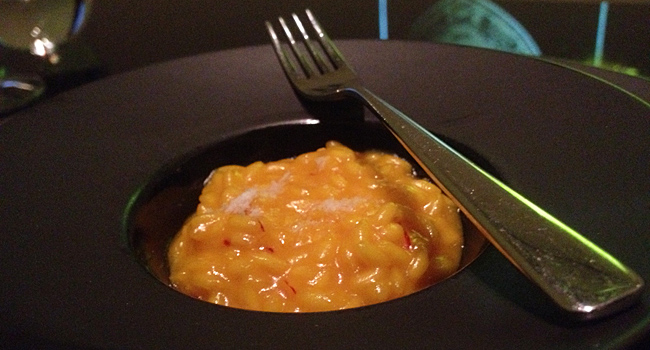
Acquerello rice risotto, chicken stock, saffron, very posh parmesan

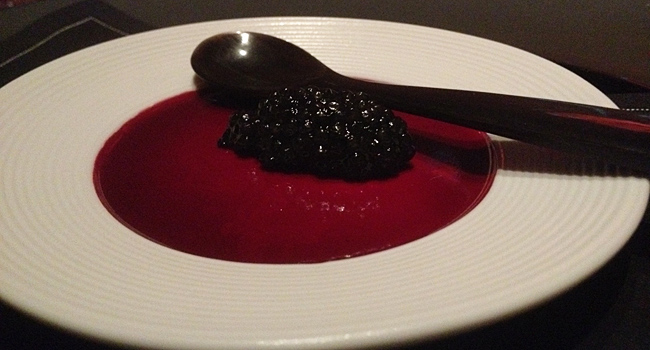
Caviar, hibiscus jelly

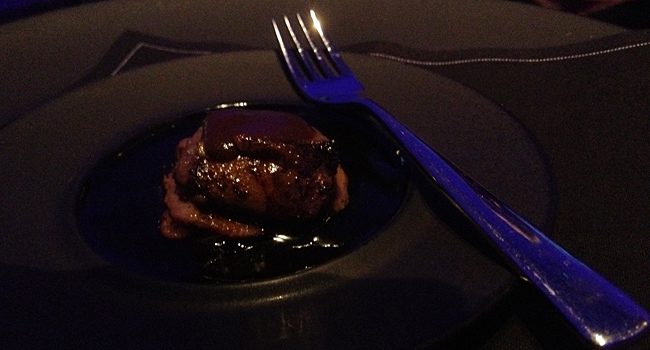
Foie gras de canard, mole negro. Listen, it's dark food on a dark plate in a dark room, don't blame me

The attention to detail here was astonishing. The food not only had to have the right colours and the right flavours, but it also had to tick the refined exclusivity box where Dom Perignon has made its home. We were served caviar, foie gras and saffron; even the rice, ultimate food of the masses, was extraordinary (Acquerello rice is grown by a single family on a single farm in Piedmont, aged for at least a year and then farted dry by genuine princesses before packaging, lending it unique starch-retention qualities. I made up the bit about princesses).

And what, then, of the wine? Well, faced with these bold flavours, it revealed the many facets of its character: salinity, minerality, florality. “The wine is assured enough to cope,” said Geoffroy. “You cannot be gentle with this wine.” Across western Europe the summer of 2003 had been extraordinarily hot, and remembering it tends to generate among winemakers the kind of horror thespians feel at the mention of “The Scottish Play“. But Geoffroy seemed thrilled to recall a year that forced him to think “outside the box when it comes to viticulture”. “The situation in 2003 was difficult enough to come up with radical solutions when it came to picking,” he said. And so, for the second time in Dom Perignon’s recorded history, picking began in August. The result is “a wine that is somewhat against the odds, against expectations”. His hope is that this wine “will be remembered as the one true witness from the vintage” – “The mistake in 2003 would have been to make it about just strength and power. Here it’s more about intensity.”

Perhaps the most incredible thing about this unique, personal and intense experience, and Geoffroy’s enthusiasm in sharing it with us, is that he’d done it four times the previous day, once that morning and had another few to come before bedtime. Still, I suppose some things are relatively easy to get enthusiastic about.

iPhone app review: WineDemon

Wine Demon (or WineDemon, as they style it, the old spacephobes) is a newish app from the people behind Naked Wines, the online wine retailer. The aim is to become something like the TripAdvisor (fellow spacephobics) of wine, creating a single place where millions of people can find millions of reviews of millions of wines. In doing so, they want to cure “restaurant-wine-list-phobia”, to put an end to “supermarket-special-offer-bafflement” and to banish “what-was-that-lovely-bottle-itus”.

This is how it should work: when you try a wine, you rate it. When you need to find out if a wine is any good, say in an unfamiliar shop with no useful staff, or in a restaurant, you can search for it and read everyone else’s ratings. These may guide you to an unknown gem, which in turn would enormously impress your date, if you have one, or warn you away from a disaster.

Let’s start with rating your own wine. This, I like. It’s very easy to find your wine on their system, and impressive how frequently they already list even my more obscure selections (even if I’m often the first to actually review them). If you can’t be bothered searching their system, or if you’ve got a wine which isn’t there and don’t want the faff of inputting all the information (not such a strenuous task, really – they only want the basics), you can just take a picture of the label and the magic elves at WineDemon HQ will do it for you. You can give it a simple rating out of 10 (it’s out of five really, but you can use half-marks), or you can add a more detailed tasting note. This is all good (though I’d like to be able to input where I bought a wine, whether I’m drinking it at home or at a restaurant).

It’s when it comes to looking at other people’s wine reviews that the first problems crop up. And this is key, because if the searchable database of reviews can’t produce meaningful data, the app is fatally flawed.

I think the major problem is this: people like wine. A lot of people aren’t very fussy about it – they just like a glass of something wet and alcoholic at the end of the day – and like pretty much anything vinous. This is Yellow Tail’s business model. But this means that, however hard some wines try, it’s actually pretty difficult to get a bad average review. However, people who consider themselves wine buffs are a different matter. This hard-to-please bunch are always liable to give even very decent wines a disappointing score if they don’t quite hit the mark. Let’s call these two groups of people Type A’s (love anything) and Type B’s (very fussy). Only Type A’s will drink the likes of Blossom Hill, so the cheaper, lower-end wines will always get pretty good reviews. Only Type B’s will drink Chateau Lafite, so the posh stuff is always liable to be marked down on technicalities. This presents some reliability issues with the ratings. Let’s look at some examples:

Yellow Tail shiraz: 85% of 157 Demons liked it, average review 3.5/5
Chateau d’Yquem: 81% of 143 Demons liked it, average review 3.5/5

Gallo Family cabernet sauvignon: 88% of 43 Demons liked it, average review 3.5/5
d’Arenberg The Dead Arm shiraz: 54% of 31 Demons liked it, average review 3.5/5

Jacob’s Creek sparkling shiraz: 84% of 100 Demons liked it, average review 3.5/5
Bollinger Grande Annee: 73% of 122 Demons liked it, average review 3.5/5

Berberana Rioja Reserva: 83% of 117 Demons liked it, average review 3.5/5
Rioja Alta Gran Reserva 904: 80% of 137 Demons liked it, average review 3.5/5

As you can see, according to WineDemon’s rating system Yellow Tail shiraz is better than Chateau d’Yquem, while the Dead Arm shiraz, one of Australia’s highest-rated exports, is less popular than Gallo cabernet sauvignon. If you want a sparkler you’re better off with Jacob’s Creek fizzy shiraz than Bollinger Grande Annee, and for Rioja you should choose Berberana’s reserva (“half price” at Tesco’s as I write, at £6.99) over Rioja Alta’s £40+ Gran Reserva 904.

(The first version of WineDemon had a glitch that led to fewer people “liking” top wines than there should have been, but I’m told it has been fixed) 

There’s a chance that they already have a way to solve this problem: it is possible to rate other reviewers, meaning that at some point in the future you could restrict results to just, say, the 10% most trusted reviewers. But you’d be needing the same people who’s ratings skew the system to be more discerning in their selection of reviewers, and I don’t see how you could possibly be confident of that. Or you could see who has reviewed your chosen wine and trust only the people you’ve heard of, though this relies on you having heard of rather a lot of people. It is apparently possible to automatically find users who you follow on Twitter, and to prioritise out their reviews, though I haven’t been able to get this feature to work.

As an aside, clearly the WineDemons needed quite a lot of reviews to get their app up and running. To encourage this, they offered free Naked Wine wine to prolific reviewers. When word got out about this offer, hundreds of people logged on and gave random marks to random wines until they’d built up enough credit to go shopping. They didn’t get their wine – it’s bizarre that any of them really expected the offer to be honoured in those circumstances – but they did leave a hell of a mess. I’m told the unreliable reviews have all been removed.

I’m finding WineDemon a great place to put my own wine reviews, allowing me to easily fish them out again at a moment’s notice, along with a picture of the label, to cure my own what-was-that-lovely-bottle-itus. But I fear that anyone relying on the community’s reviews to help them out with an unfathomable wine list would probably be better off just closing their eyes and picking something at random.

I’ll keep using it for to review wine, and I’ll keep checking the average scores optimistically. Perhaps TripAdvisor also went through this phase, and with time, and with lots more reviews, WineDemon will become a more reliable source of recommendations. And perhaps Yellow Tail really is better than Yquem – I don’t believe I’ve ever tried either.

New year’s shirazamatazz*

I saw in the new year in the Lake District in the company of my wife’s extended family, fully 15 of them. If I were Bernard Manning or Les Dawson I would make a few jokes about my mother-in-law at this point, but the truth is that she’s no monster and my wife’s family is in general rather of a delight. I write this even though none of them read this blog; indeed, if there’s one really serious family failing it’s a general lack of hoot-giving about wine.

Perhaps they’re aware of this, as I was asked to put on a wine tasting for the assembled crowd on New Year’s Eve. Of course I accepted, and set about compiling a small spread of themed wines. The theme I chose was syrah/shiraz, hoping that the wines would at least be sufficiently warming to see us through a chilly winter’s evening in the north of England. On the plus side, I thought, there aren’t many more popular red grapes out there. On the down side, anyone who didn’t like syrah/shiraz was in for a crap evening.

There were seven wines, three from France, three from Australia and a sparkler from Spain. They weren’t entirely representative, particularly given that some of my favourite syrahs come from New Zealand, but they made for an interesting selection. They were: A 2009 Cave de Tain Crozes-Hermitage, Les 3 Lys, from Sainsbury’s (£7.49); a 2003 Thierry Allemand Cornas from my fridge (worth about £40); La Pamelita, a sparkling shiraz from Spain bought from Theatre of Wine for £15; Jacob’s Creek bog standard shiraz (widely available for around £7.49-£7.99, but often on promotion); Penfold’s Bin 28 Kalimna shiraz 2008 (widely available, about £10-£12) and D’Arenberg Dead Arm shiraz from 1998 (from a friend’s cellar, but also worth about £40). There was also a bottle of Mas Coutelou’s 2010 Vin des Amis (Roberson’s, about £10 by the case when it’s in stock), which has a bit of syrah in it but is mostly grenache.

With all the bottles covered in special bags, I asked everyone to choose which single wine they’d like a proper glass of after the tasting, and which they thought was the grenache-based ringer.

My favourite, and the favourite of my two keenest co-tasters, was the cornas (which, like the d’Arenberg, I had double-decanted a bit earlier, primarily to filter out sediment, of which there was plenty). A super-hot year, 2003 is widely considered one to avoid in much of Europe, and I picked up a case of this from a Justerini & Brooks bin-end sale last year for precisely £20 a bottle. At that price I think it’s a pretty special wine, complex and characterful yet classy in a way that’s not easy to find at this price point. The next keenest family member, though, who I had high hopes for given that he has spent the last couple of years living and working in Italy, asked for a glass of the Jacob’s Creek, which to me stood out as the worst wine by a long distance in an otherwise impressive field (it’s always worth trading up to their reserve range, if you’re going JC).

There was one extra test: everyone got a sheet of paper on which I’d printed tasting notes on the seven wines on show (not mine, a professional’s, sourced from the interweb), as well as two rogue tasting notes, one which described a valrhona chocolate bar and the other a coffee from web-based retailers Has Bean. Given that many of the wines were vaguely similar and no one there was an experienced taster, match the tasting notes to the wines was an impossible task, but I asked them to work out which were the two ringers. One, everyone got. The other slipped through the net. I’ve made this very slightly harder for you by deleting the giveaway mentions of “this wine” or “classic northern Rhone syrah” that I kept in for the family, but regular tasting-note readers probably shouldn’t be too long detained. See which two you think are the odd ones out (without using Google, of course).

1) Totally opaque colour with purple crimson hue. Aroma of liquorice allsorts, spice, blackpepper and vanilla with just a hint of marzipan. Flavours of vanilla, plum and liquorice. Long aftertaste of vanilla, plum and spice.

2) Light, aromatic and spicy, with notes of woodsmoke and grilled meat and crisp acidity.

3) High-pitched, very fresh red and dark berry notes, with complicating accents of licorice, violet, rose and magnolia. Full and lush in the mouth, with almost jammy blackberry, cherry cola and cassis flavors.

4) Rich, full taste of yellow fruits such as plum and cherry plum, with acidic notes.

5) The nose shows ripe plum and spicy fruitcake aromas, with hints of currant, chocolate and well-handled cedary oak. The palate is medium bodied in structure, with ripe plum fruit flavours.

6) Lifted spicy nose with blackberries, mulberries and ripe figs dominating. Underlying hints of wild thyme, musk and cloves. A true one-off and a treat for the tastebuds

7) Buckle your harness, this is going to hurtle you straight through the sound barrier. Its sheer power of all manner of black fruits, integrated dark chocolate and liquorice is beautifully framed.

8) Lovely, stony minerality augmented by a host of flavours that, while still young and primary, are rewarding. Touches of forest fruit coulis, redcurrants, sweet damsons, herbs and a perfumed lift. Utterly delicious, both crunchy and lush.

9) Expect plum and nectarines, mixed with a lovely spiciness of fresh cracked black pepper, a fantastic mouthfeel and finish of cherry

I’ll put the answers in as a comment, so scroll down a bit if you want ’em.

* I know only Olly Smith can get away with using words like “shirazamatazz”, and I apologise.

New Year, old world – a Wine Society “mystery” case

At the start of 2011 I resolved to spend my wine budget more freely, rather than getting overexcited in the Waitrose sale, snaffling a couple of cases from the Wine Society somewhere along the line and not really having much time, space or money left for anything else. And I succeeded spectacularly well, placing my first orders with a good half-dozen merchants, and even dipping my toe into the world of auctions. In many ways I succeeded much too well, and much too often, so as a result this year’s resolution is to scale back a bit, and to make sure my wine fridge never overflows. Promisingly, I’ve already let a couple of new year sales pass me by, and for my first wine purchase of the new year I went back to a familiar source.

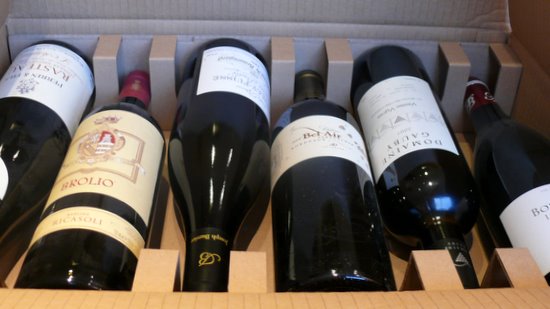
For some time I’ve seen the Wine Society occasionally offer “mystery” mixed cases of wine without ever being seriously tempted, but this year I had a change of heart. The worst that could possibly happen, I decided, is that I feel ripped off and get myself a furious blogpost with which to start 2012, which wouldn’t be so bad. So I spent £79 on six mysterious “fine wines”, the cheapest of their secret cases (which go up to £220 for six clarets), which was to contain four reds and two whites, comprised of a Claret, a Rhône and a white Burgundy plus either a red Burgundy or a Beaujolais, a white and a premium non-French red. I was promised a saving of £15.

This is what I got:
Bourgogne Les Pince Vin 2005, Alain Burguet (TWS are currently selling the 2006 for £19)
Chateau Bel Air Perponcher 2006 (TWS are selling the 2009 for £8.95)
Barone Ricasoli Brolio Chianti Classico 2006 (winedirect are selling the 2009 for £14.50)
Perrin Rasteau l’Andeol 2007 (AG Wines are selling for £14.29)
Domaine Gauby Vieilles Vignes Cotes Catalanes 2007 (AG Wines are selling for £25.99)
Pouilly-Fuisse “Vers Puilly”, Chateau de Beauregard 2009 (Which I can’t find anywhere else, though James Nicholson have their “Vers Cras” cuvee for £26.99).

Those retail prices add up to £109.72, which makes my saving considerably higher than advertised (almost exactly double the £15 they promised, in fact). Of course, the downside of this kind of case is that you end up with wines you wouldn’t necessarily have chosen yourself, but I find that (subject to certain minimum standards being met) I enjoy wines I probably wouldn’t ordinarily have bought myself (but did anyway) at least as much as those I would. In this case, the Bordeaux and the two Burgundies stand out as the wines least likely to have found their way into my house any other way.

If I have a complaint with my case it’s that they could have thrown in a wine from the new world, or more from places that aren’t France. If you push me for a second, it’s that the Wine Society seem mildly obsessed with flogging me Chianti Classico,  having already sold me six bottles of Brolio’s 2007 (and a couple of others) through a Vintage Cellar Plan (another way for them to decide what wines they sell you) I share with a couple of friends.

I write this, incidentally, while sipping a classy, creamy zibibbo (that’s a grape), Pietranera from Marco De Bartoli in Sicily, bought from the brilliant Les Caves de Pyrene during my adventurous 2011. If only they only offered cut-price mystery mixed cases…