Category Archives: Uncategorized

Camino: Puerto del Canario – Getting merry with sherry

Last year, the sherry producer González Byass lamented the inexorable decline of sherry consumption in the UK. “We can’t turn the market,” their UK marketing director sniffed, adding forlornly: “we’re not giving up.” A spokesman for Fedejerez, the sherry trade association, said: “We need to make sherry trendy like running cocktail competitions. That is the way forward.”

A year earlier, Harvey’s – whose Bristol Cream is the very quintessence of untrendy sherry drinking but nevertheless snarfs 29% of the market by volume – announced a redesign and a first step down the long road to fashionability. “As the UK’s No1 sherry, it is our responsibility to drive the category into the 21st century,” said their brand manager, suggesting that people should mix their Harveys and lemonade. “Sherry is a versatile drink which can be enjoyed on many occasions.”

They have since targeted “independent 25- to 34-year-old women who are confident in their choices and are happy to stand out from the crowd”. They sponsored this year’s London Fashion Week, where they “specifically demonstrated to younger consumers how the brand can fit into modern lifestyles” and pledged to “reinvigorate and contemporise sherry and bring in younger consumers, something which is crucial to the category’s future success”.

Lots of people are trying to make sherry cool, yet still it sits, neglected, on the supermarket shelves, from whence it rarely moves despite near-insulting prices – Manzanilla La Gitana, a genuinely delicious companion to a summer sunset and a few olives and regularly lauded by critics, costs less than £8.

Then there’s Richard Bigg, the man behind Kings Cross Spanish-themed hang-out Camino: Cruz del Rey and its entirely sherry-focused little brother Pepito, and now the all-new Camino: Puerto del Canario in Canary’s Wharf. “Sherry is druggingly delicious and I think the public are ready for it,” he told Decanter earlier this year, and certainly the critics are – the original Camino was named bar of the year in the Observer and Pepito is Time Out’s best new bar of 2010. Now the experience is being rolled out to high-flying City types, Jubilee Line extremists and Thames Clipper boat-trippers (it’s a mere olive pit-spit from Canary Wharf Pier).

I was not immediately bowled over. It’s the second outlet, but it looks like the 50th. From the branded t-shirt-clad staff to the Belgo-style industrial-chic aesthetic, it reeks of chain. There’s not much they could have done to add character to what is a very shiny new development, but I certainly prefer the exposed brickwork of the Kings Cross original to the meshed metal and bare pipes in Canary Wharf. The place must be transformed in summer with the front opened up and the Thames flowing past – to see the best of it, from the food to the river view, you’ve got to look past the interior design.

There’s nothing offputting about what they give you to eat, though. A lot what I tried was simple but excellent – greaseless calamari, slice-with-a-fork-soft octopus, delicious thin-sliced pork shoulder, excellent rib-eye steak “served basque style” (cooked, on a plate – those Basques have a fairly simple style), and simple-but-dreamy vanilla ice cream bobbing in syrupy pedro ximénez. The menu is identical to that in Kings Cross, with the kitchen again overseen by Nacho del Campo, the most unassuming of head chefs who came to Camino from Spain via a dreadful-sounding place in Exeter. Most things cost around £5, with only the bigger steaks and sharing platters exceeding £10. If you’re hungry you’ll probably spend about £25 a head on food, and you’ll taste lots of nice stuff and feel full and happy.
The all-Spanish wine list has plenty of interest at all price levels – seven reds and six whites at or below £20, up to a Vega Sicilia Unico 1999 for £290 (from a “Big Guns” menu that you won’t find in Kings Cross). It’s also particularly easy to decipher, with all the grapes listed to help you on your way. My wine of the night was the Torre Silo, Cillar de Silos, a seriously food- and mouth-friendly tempranillo that at £54 is sadly a little less friendly to your wallet.

And the sherry? Well, there are seven on the menu (not bad, though there are 15 at Pepito), no sherry cocktails and not even the suggestion that you give it a go with lemonade. A fino would be near enough unbeatable on a warm afternoon, stretched out on the terrace with the river rolling past, some tapas on the table and the sun in the sky, but as the nights draw in perhaps it’s just as well to concentrate on the food.

Class in a glass

I fear that there is only so much complexity I can take. Not long ago, if you wanted to learn about wine you studied France, Italy, Spain and Germany. Even that adds up to a lot of information, frankly. Now you’ve got the Americas, South Africa, Australia and New Zealand, eastern Europe coming up the rails, the promise of Asia, some action in north Africa, even dear old Blighty. Hundreds of grape varieties, thousands of wine-growing areas, gazillions of different styles.

Even once you’ve decided on what you want to drink, you’ve still got to get it into your mouth – and that’s not as straightforward as it sounds. Most people would agree that wine should go from the bottle into some kind of glass or cup before it is consumed. And most of us would agree that a decent wine glass would be the recepticle of choice. Fine, great. I’ve got some decent wine glasses. So I’m good, right? I’m all sorted?

A couple of weeks ago Maximilian J Riedel, 11th generation scion of the German glass-making dynasty, convinced me that I’m not. In fact, I’m some way from being good. And I don’t think there’s anything I can do about it.

He has been hosting a series of tutored tastings, in London and around the world, aimed at showing wine-lovers how good he is at swirling wine in a glass (amazing – so elegant! And with such nonchalance!) and more importantly that they need to spend lots of money on loads of glasses. Of course, he would say that – his company makes glasses (other glass manufacturers are available). But dammit if he isn’t actually right.

At my tasting we tried two wines in a variety of glasses. With one, a Berton Estate Reserve Cabernet Sauvignon from 2007, there was a noticeable difference when it was drunk from the appropriate vessel, but frankly not one that would have me running to my nearest glass-purveyor waving an open wallet. With the other, a Coniglio 2002 chardonnay from Hawkes Bay, the improvement when drunk from a specialised chardonnay glass was frankly astonishing, revelatory. In the “wrong” glasses there was too much acidity, nudging towards harshness; in Riedel’s Montrachet glass it woke up, and what was clearly a good wine showed itself to be a stonker – possibly my all-time favourite New World chardonnay, in fact. At upwards of £25 a bottle it should be good, but in the right glass it improved by perhaps 15-20%; perhaps a finer, more complex red – the Berton costs around £9 a bottle – would have proved its point a little more forcefully as well. “If you want to enjoy wine at its best, we believe that you need to have the right messenger, the right glass,” Riedel told us.

And they’ve got lots of messengers. The standard Vinum range – and this is just dipping a toe into a sea of complexity – has a glass for aged chardonnay, another for young chardonnay, and further glasses for Brunello, Burgundy, Bordeaux blends, syrah, tempranillo, zinfandel, sauvignon blanc, champagne, extra-special champagne, riesling, kalterer see auslese (nope, me neither) and “young, fruity, acidic, dry light white wines with less than 12% alcohol”, plus many others for sake and all sorts of spirits and fortifieds. The science bit, such as it is: Riedel showed us that different glasses deliver the liquid into your mouth in a different shape, apparently altering the way your tongue decodes them. True enough, when you put some chardonnay in a riesling glass the liquid looks like the top of the Gherkin as it arrives in your mouth, while in the Montrachet (right) glass, it is rounded like half a football. They also change the way you perceive smell, apparently, but that you can’t see so much.


A handy pictorial guide to chardonnay mouth-entry shapes


So the glasses work, then. But with an RRP between £15 and £20 apiece (these are machine-blown glasses, nowhere near the top of Riedel’s range), if I had to kit myself out for all the different wines I might expect to drink I’d be straight down the pawn shop with the PlayStation and Mrs CF’s engagement ring. And then I’d have to build a new extension just to house them.

So what to do? Oh hang on, Maximilian’s holding a decanter.

“Every wine must be decanted,” he says. “Red and white and Champagne.” I have one decanter, which I got for Christmas and use once or twice a month. He pours us two glasses of the same wine – a Chianti Classico – one from a decanter and the other from the bottle, but I am unconvinced that decanting made much of a difference. “I wouldn’t say it changes the wine,” he says, “but it makes it mature.” Riedel’s favourite decanter, named Eve after his mother and designed by him in 2008, is over 50cm high, costs £375 and comes with an instructional DVD. A lot of their stemware is beautiful in its elegance and simplicity, but some of Riedel’s decanters are ostentatious to the point of absurdity.


Have you got a cupboard for this lot?


It is interesting that while Riedel have been selling these glasses for 30 years and more, there is still no clear consensus in the wine world. Most restaurants, even the very finest, use one glass for all styles of (dry, still) white wine and another for all the reds. Yesterday I was talking to one of the people behind 28-50, the new wine-focused restaurant off Fleet Street (more of which another day), and though they have more different glasses than most he was very sceptical about Riedel’s ideas.

Whatever the merits of his argument – and I am convinced that there are plenty – I have neither the finances nor the storage to launch myself down the Riedel route. And so I must continue to use the wrong messengers, and hope my wines shout loudly enough for me to hear them anyway. And I fear there is a point where the world of wine reveals itself to be so complex that all but the most determined of explorers simply gives up, waves a little white flag and goes and gets himself a pint of lager (though even that isn’t always so simple).

But from now on, until I take out a second mortgage and build that glass-storage extension, whenever I drink wine at home (except for the two varietals I happen to have the right glasses for) I’ll wonder if it could taste 15-20% better. This does not make me happy. At all.

Don’t read all about it

A recent survey by Wine Intelligence – “the global company dedicated to supporting wine businesses and associations through consulting, branding & market research,” I’m told – brings good and bad news for the British wine industry. On the plus side there are more regular wine drinkers than previously, with 28 million adults admitting to drinking the stuff at least once a month, five million more than in a similar survey in 2007. On the downside, those 28 million people drink wine, on average, 9.5 times a month, down from 11 three years ago. That still means (taps calculator for a while) that each month there are 266 million wine-drinking experiences, up by 13 million from 2007, which adds up to rather a lot of wine. Meanwhile the average spend on a bottle of wine to drink at home has risen in the same period by 29p, from £4.69 to £4.98, which given that excise duty has risen by 33p means we’re actually spending a few pence less on the wine than we were doing in 2007.

The report actually says lots of other things, but seeing as it costs £2,500 a copy I’m going to stick to what’s in the press release.

With the population at around 61,792,000 the last time the government took a guess, this all means that 45.3% of British grown-ups drink wine regularly. It also means that more people drink wine than, say, watched the World Cup final (18.4m people, on average, this year), or go to the cinema (only 18% of Britons go once a month or more), or are married (21.7m people, according to data from 2005). The number of wine drinkers is only fractionally smaller than the number of people who vote in general elections (29,691,380 this year) and totally dwarves the number who go to church (7.6m people go at least once a month, 12.6m once a year).

In other words, there’s a lot of us doing it. Wine is big. Statistically (this is a sentence I may come to regret), wine is bigger than Jesus. But however much we enjoy it, we don’t tend to seek out information about it. We are happy to drink in ignorance. Decanter, the country’s only mainstream wine-focused consumer magazine, has a UK circulation of around 22,500. That’s not many more than the 21,084 astrology fans who read the BBC’s Sky at Night magazine. More people get the Warrington Guardian, or the Rotherham & South Yorkshire Advertiser. Many fewer people go to the cinema regularly than drink wine, but the country’s biggest-selling film magazine, Empire, sells 179,000. Wine critics in the national press get a fraction of the space afforded to movie reviews, or fashion, or the extra-marital proclivities of footballers.

The wine industry, demonstrably, is a very long way from being in crisis. But with so much interesting stuff to know, so many stories to tell, it would be good if people could become interested in more than simply consuming the stuff.

Any ideas?

International Grenache Day: how many days do these grapes need?

As it happens, this Friday is International Grenache Day. This might come as a surprise, particularly since it’s only three weeks since Cabernet Day. How many days to these grapes need?

Much as I enjoy many of the wines it is intended to celebrate, nothing about grenache day is likely to give me as much pleasure as the promotional material announcing it. “We should all try to wear a loud shirt, to proclaim our love of Grenache and get it the attention it deserves on this, Grenache’s first dedicated World Day!” it bellows. “We’re asking all of you Grenache fans to approach your neighbourhood restaurant and/or favourite wine retailer to [demand] a special Grenache-centred activity.”

If I approached my favourite wine retailer wearing a loud shirt and demanding a special grenache-centred activity, I could probably expect to leave with a seriously tarnished reputation and a bottle of Chateauneuf-du-Pape, probably the most famous wine in which it usually takes the starring role. But does grenache even need all this attention? It is, after all, the world’s fourth most-planted varietal. In France it is No2 behind only merlot while in Spain it is top of the red grape charts and spread across 120,000 hectares – an area, fact fans, almost exactly the size of Bedfordshire. Plus there’s a fair amount of its pale-skinned cousin, grenache blanc, and a scant smattering of grenache gris. There are plenty of genuinely obscure grape varieties which could use a bit of publicity – International Reichensteiner Day might help everyone learn a thing or two – but grenache?

Well, because it is most frequently used in blends, and much of the time isn’t even mentioned on labels, many in the business consider grenache deprived of attention. Plus 40,000 hectares worldwide have been dug up over the last decade, making it officially threatened. But most importantly it’s worth celebrating, no matter the date, because it frequently goes to make brilliant wines in a dazzling range of styles. For most of the year in the CellarFella household grenache day falls about twice a week.

One or other member of the grenache family sits at the heart of many of the most enjoyable pinks, reds and stickies from Spain, France and elsewhere. Recently I’ve been loving Oddbins’ Domaine Mas Theo Coteaux du Tricastin 2007, a peppery, vibrant organic equal blend of grenache and syrah from the Rhone valley, and developing a taste for the fortified reds of Banyuls such as this one from the Wine Society – one for completists containing as it does the full house of grenaches noir, blanc and gris. I’m not convinced about the merits of International Grenache Day, but all the same I’m ready to proclaim my love of this incredibly versatile family of grapes (though the loud shirt might be a step too far).

Too many interesting things to look at, chance of head exploding

Erik S Lesser for The New York Times

If you’re at a loose end this morning, may I humbly recommend these things, at least two of which are wine-related and absolutely all of which were discovered, directly or indirectly, via Twitter:

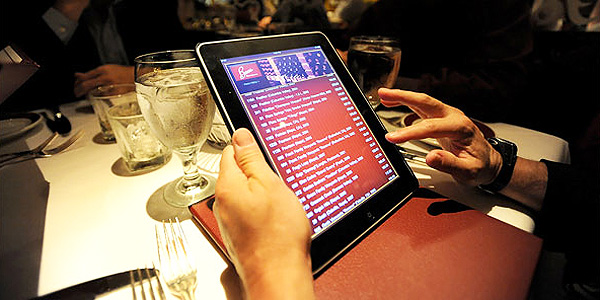
• News that restaurants are swapping doorstop wine lists with iPads, all loaded up with their list, reviews, winery information and inevitable Robert Parker scores. See (in descending order of interest, but all on-topic) here (from yesterday’s New York Times) and here (The Economist, today) and here (Jancis Robinson, a couple of weeks back) plus, from a few months ago, here.

Michel Rolland says something predictably provocative, suggesting wine should be more like Coke – designed to taste predictable, but with flavours deliberately altered according to the target market. “Here in France, and particularly in Bordeaux, we must stop believing that we have a monopoly on the definition of taste,” he says.

This is funny. And so is this.

Naked ambition

A while ago Naked Wines sent me some wine without me paying for it, and this is the first time I have mentioned these wines. This presents an interesting but not entirely new dilemma – back in the real world I have quite often covered the team I support (their identity remains a loosely-guarded secret, because I’d quite like to do it again) for The Guardian or The Observer. Of course I try not to show my bias but other fans of the same team have criticised me for being over-harsh by way of compensation. Personally I always thought I got the balance about right – though that’s one subject I’m definitely biased about.

Fortunately for my credibility as a serious football journalist, my match reports didn’t have a big “disclaimer: this writer is a fan of one of the competing teams” sign on it – but this is my blog and honesty is important. Anyway, I’m not a fan of Naked Wines and have no interest in praising their wines unnecessarily.

Well, I say I’m not a fan. I do quite like a lot of the things they do. They encourage winemakers to correspond with consumers on their website, which I think small producers should do a lot more of. Their website promotes discussion about and contemplation of wine, two very good things, and a connection with the places it’s produced and the people who produce it. And they have a system vaguely similar to en primeur called “advance bookings”, whereby consumers pay for their wine some time before it arrives, at a considerable discount. I’m not entirely sure how the sums work for this one – they are currently selling six bottles of Grasshopper Rock Central Otago Pinot Noir, a well-rated wine that’s available by the half-case in New Zealand direct from the producer for £92.38, for just £59.16 – but I like them. In fact, I liked that one so much I bought some. So long as the answers are good, the sums can work however they want.

What it means is that the producers clear out their cellars and get lots of money quickly and without risk, Naked Wines don’t have to splash out on storing wines while they find people to buy them, and the people from the recent International Wine Challenge awards didn’t have to look very far to find someone to hand their Innovator of the Year gong to.

Naked Wines also like their wines to be exclusive. But take, for example, the first of their wines that I opened – Brewery Hill reserve shiraz 2008. Brewery Hill doesn’t exist. The wine is in fact made by Chalk Hill, and does very little to hide it, printing their address on the back label. This is not a bad thing, Chalk Hill being a very decent winery, recently awarded a full fair dinkum bonanza five stars in James Halliday’s Australian Wine Companion 2011. They’re quite a big organisation, with grapes sprouting all round McLaren Vale, but this wine is available nowhere but at Naked Wines, who get a special thankyou on the label. How similar it is to Chalk Hill’s own-label shiraz, available elsewhere for a fair bit more than this, I don’t know. Naked Wine also sell a couple of Chalk Hill wines with Chalk Hill labels, though there’s no sign of those on Chalk Hill’s own website.

None of which makes any difference to what’s in the bottle, which is good stuff, a big, bold, bright character of a wine, the kind of wine that isn’t shy about having a go at the karaoke. Barossa and McLaren Vale shirazzes tend to be quite outgoing and brassy, so it’s just about whether you like to have a character like that hanging out in your living room. Mrs CF loved it, as do most of NW’s customers, but though it’s an entertaining crowd-pleaser I’m not sure it’s fabulous value (compared with, say, this from the Wine Society). Still, it’s well-made Australian shiraz, full of fruit and oak and velvet and alcohol (14.5%), and probably wearing a bright pink feather boa while watching America’s Next Top Model.

Brewery Hill Reserve Shiraz 2008 costs £11.99 from Naked Wines. More on their other wines to come, possibly without the extravagantly long preamble.

Harvest time

Photo by Ryan Opaz, http://www.catavino.net

It’s not just our schoolchildren who approach the start of September with trepidation, the end of a long period of relative calm and a few days that can set the tone for an entire year. For this is the start of harvest season, and across Europe winemakers are preparing for and indeed already engaged in action. Twitter is atweet with news, Flickr aflick. Rain at last in Bordeaux. Rotten grapes at Bonny Doon, action in Montalcino.

Some have already started, with early-ripening white grapes the first to go. In Bordeaux the pickers moved in, so far as I can tell, on 1 September; the harvest in Champagne will get under way this week. In Rioja they’ll be drinking this year’s wine within a fortnight, when the raucous annual harvest festival in Logrono begins on 20 September. The harvest festival in Jerez is already in full swing.

The decision to harvest is made using a mixture of science, intuition, meteorology and blind optimism, all to pick the optimal moment when grapes are fully ripe but not withered or diseased, and crucially before the weather turns nasty and ruins everything. But there are countless other decisions, down to the time of day when the pickers get to work: at Chateau Petrus they leave it until the afternoon to give the dew time to evaporate, but fellow Bordeaux big-hitters Chateau Haut-Brion do it first thing in the morning, when the grapes are cold and firm (nothing left to chance here – even though work starts at 6am and the vines grow just yards from the cellars a fleet of chilled lorries are at hand to shuttle the grapes from one to the other, cooler than the Fonz in a fridge).

If the winemaker’s job is hard, the grape-picker’s is harder. A study of American vineyard workers found that their average working heart rate was 119bpm, making a day in the fields a bit like spending eight hours on the treadmill. They also found that, of the workers who were fit and healthy at the start of the picking season, 70% were reporting musculoskeletal disorders by the end of it.

It is terribly kind of everyone to go to so much effort on our behalf. The British, because we produce so little of our own world-class wine but consume so much of everyone else’s, are probably the most spoiled nation of drinkers on earth. One can hardly complain that we get to experience all of the gain with none of the pain, but at this time of year it’s worth sparing a thought for those who put their sweat into our wine. Not literally, I hope.

The circle game

Just a short post because I’m struck by something interesting and I happen to be on a computer. I’m at home, where wine of the evening is a Bierzo, El Cayado, which I bought from Oddbins for £8.99 after I saw it recommended on Jamie Goode’s WineAnorak blog and by Tim Atkin in the Times, two experienced wine writers with good judgement who I trust. I don’t have much experience with Bierzo as a region, but remember one – which retails at an only slightly more expensive £11.75 – I had in a restaurant a couple of years ago which got me quite excited at the time. So excited, in fact, that not only did I buy a bottle of this when I went to my local Oddbins, but I’ve got another two coming as part of a mixed case which should arrive any time now.

So I open the wine. I’m looking forward to it. It’s going to be good. But then, it isn’t great. It has none of the wild funkiness of the Pittacum (though I’m reaching pretty far back in my wine-memory cellar for that); it’s decent but it certainly isn’t thrilling, there’s just no complexity of flavour. It doesn’t taste faulty, it’s just average. So I go back to WineAnorak to check what Jamie said about it, and at the top of the page, posted yesterday, is a new post, complaining that he too had bought a bottle from Oddbins and found it disappointing.

Turns out they’ve just changed vintages (though pretty quickly after sending their samples of last year’s vintage to the press pack, it has to be said). There are no villains in this story, though there are a couple of bottles of disappointing wine heading my way.

CF goes out shopping on tour and probably has to give up these silly and way too long intro bits: L’Epicerie Fine, Forcalquier

So I’m in France, where they are much better at making wine than the English but not as good at selling it. I mean, they’re great at selling their own wine, but pretty useless at accepting that anybody else, even the Italians, might have a product worth adding to their shelves. Which is bad for the French, but good for the English bloke in France for a fortnight and happy to try something local and obscure. Having been fairly emphatically disappointed by the selection in my local Carrefour, I found myself in a town I had never, until the moment I arrived there, heard of and went in search of something better. It was a short search, and ended at a small shop which sells cold meats, teas and coffees and a selection of wine that had burst out of its allocated shelves and into a couple of fridges and assorted wine racks squeezed into improbably spaces around the shop. I recognised a couple of labels from Les Caves de Pyrene, and engaged the owner in conversation about natural wine, which turned out to be his passion. I pointed to a wine called Le Soif Du Mail, which I tried at the Les Caves sale and enjoyed so much I bought four (sitting, with the rest of the Les Caves booty, in my parents’ basement for the time being). “Well,” he said, pointing to one of his wines, “if you like that, you simply must try this.” The wine he was pointing to was called Il Fait Soif, leaving the possibility that he thought I simply liked wines with the word soif in the title. “Oh, and this. And you’d probably enjoy that.” Neither of the last two wines had the word soif in the title.

And so it was that on my second shop review I abandoned the randomiser and just bought everything he pointed at.

Il Fait Soif 2008

Reduced to 10 Euros from a little under 14 because they want to move on to the latest vintage, this is made by Maxime-Francois Laurent, who also works with his mother at Domaine Gramenon. In America it costs $30 and is sold as one of the finest Cotes du Rhone on the market. I’ve struggled to find out much about it – the label is singularly unhelpful, there’s no rear label at all and Maxime-Francois doesn’t seem to have much of an online presence, but it appears to be “un cuvee de grenache”. It’s really excellent for the (my) price – very leathery odour, but quite a complex array of berry flavours and an incredibly peppery aftertaste. Really very peppery indeed. Excellent late-summer sit-outside-with-your-feet-up wine.

Babiole 2008

Andrea Calek is so devoted to his vines that he sleeps in a caravan in the middle of his vineyards. No sulfur at all in this blend of 40% syrah, 40% carignon and 20% grenache. A faulty bottle, methinks: I wasn’t too put off by the slight efervescence on the tongue, but the overpowering aroma (and flavour) was of pickled onion. I don’t like eating pickled onions, and I certainly don’t want to drink them. Perhaps this is why everyone else uses sulphur. (EDIT: When I told him this on my next visit, he gave me another bottle, which was much better but just not as vibrant and action-packed as the other two)

Domaine Jean David Seguret

Another hit. 71% grenache, 8% mourvedre, 6% syrah, 6% carignan, 4% counoise and 5% cinsaut. Cuvee Beau Nez, it’s called. Quite wild aromas (and with the wine glasses I’ve got at this rented villa it’s amazing it can smell of anything) of bramble and menthol and leather and tar. Amazingly vibrant fruity palate, really juicy. Again, not a jot of sulphur, but a better advert for the practise than the last.

Design: 4/5
Service: 5/5
Free tasters: 0/5 (there was a moment in our conversation when I waved at a wall said, “I don’t know any of these wines”, and he said, “Well, you need to taste them.” I got excited, thinking he was about to crack open a few for my entertainment and instruction, but it turned out he expected me to actually buy them first. Not unreasonable, really, but mildly disappointing in the circumstances)
Recommendations: 4/5
(incidentally, if you happen to be in this part of the world, I can recommend a small, obscure, out-of-the-way, crammed-with-locals bistro called Chez Jules in Puimichel for blindingly cheap delicious food)

CF goes out: an incredible London day-trip that everyone must do

I’ve lived in London a very long time, long enough to have assembled quite a long list of outings that I can pleasurably repeat, but it’s still difficult to recommend them to other people, particularly people I don’t know very well. I’m a man with my own tastes, and I wouldn’t presume that anyone who isn’t me would necessarily share them. This one, though, is different. Some things are just impossible not to love. It is unimaginable to me that any decent, right-minded person would not like, say, a perfectly ripe fig, a beautiful sunset, Dusty in Memphis, a moment of genuine slapstick comedy. This is pretty much up there with them. If you enjoy life and food, this is for you. If you do it and have a bad time, then either you have been catastrophically unlucky with the weather or you and I will never be friends. Have I made myself quite clear?

Highlights of the day included sunshine, lying in long grass with a newspaper, gorging on plump, sweet blackberries straight from the bush, a delicious lunch in a top restaurant, quirky historical factoids, rivers, lakes, streams and herds of magnificently antlered deer. There’s a lot here to like.

I take absolutely no credit for discovering the walk. It’s part of the Capital Ring, one of the good things about London that most people who live there don’t know about (not a short list) – a 78-mile circuit of London, split into 15 bite-sized chunks, which runs very roughly around the outer edge of London Transport’s Zone 2, connecting lots of parks with short sections of road walking. This bit starts at Wimbledon Park station, takes you through Wimbledon Park, Wimbledon Common and Richmond  Park before ending with a trundle down the Thames to Richmond itself. This is section six. You can find idiot-proof directions here.

I live in north London, a long way from here. If I get this far down the district line it’s either to go to the football or the tennis, so rather shamefully it was all new to me. Wimbledon Park isn’t fantastic, though their infants get an enviable paddling pool and there’s an excellent boating lake, but the walks improves rapidly from there. The common and Richmond Park are magnificent; in addition to the deer, the latter has a glorious home that once belonged to the official molecatcher – the official molecatcher, mind you – and a small hill with a fancy name (King Henry’s Mound, since you ask) with a view down a corridor of trees to St Paul’s Cathedral which can never be obstructed, not ever, by law.

Soon after you leave Richmond Park, and only about 100 yards off-route, is Petersham Nurseries, a garden centre that houses Skye Gyngell’s excellent restaurant and its accompanying tea rooms. The restaurant is expensive – they recently scrapped their cut-price weekday lunch, leaving you with little option but to fork out near enough £30 for a main course. That little option is to grab a soup or sandwich at the really quite good-looking tea-room next door, decorated – as all tea-rooms should be – with a pile of extremely sexy brownies. I splashed out on guinea foul, juicy inside but with amazingly crispy skin, which came with a very generous helping of girolles and spinach, followed by a pannacotta with a blackberry compote. There’s nothing fussy about the cooking, or the room it’s served in. It’s probably the best restaurant in London which would let you in with muddy boots. And from there it’s a 20-minute stroll down the river to Richmond, and thence back home, sated in more ways than one. One of the best days I’ve ever had in London. I urge you to have a go.