Category Archives: Uncategorized

Wine bargain alert – it’s the January sales!

So long, then, happiness, and a jolly-as-I-can-muster hullo to the very bitterest, coldest, miserablest couple of months in the calendar. There’s nothing to look forward to now except the imminent VAT rise, and across the land the only sound to be heard is the post-festive pop of wallets being staplegunned to solid surfaces and the desperate scratch of pencil on household budget crisis planner. It’s a time of figurative belt-tightening, when most people have resolved to spend more time in the gym rather than the offie. Well more fool them, I say. Because the only good thing about January is that the dismal weather provides you with the perfect excuse for staying inside all day checking out many virtual sales from online wine retailers.

So here, to help you on your way to an even greater level of penury, is a link-heavy list of all the post-festive wine sales I can find, good and bad. I have to say I haven’t seen anything irresistible as yet, which is just as well given that I currently have so much wine at home I was recently forced to hide some in my one-year-old son’s wardrobe, but I’ll let the world know via Twitter the moment that I do (and I’d appreciate it if you let me know if you beat me to a particular bargain). I’ve edited this list a few times when new sales have come online, but I think the sales season is almost done.

January wine sales:

Armit – most of the wines are offered by the case, but some decent discounts and a few wines down below £3 a bottle.

Averys – I’m always put off because their website looks superficially like Laithwaites’, and because their association with The Telegraph raises my Guardian-employed hackles. Totally irrational.

Berry Bros – A few decent bargains here, with percentage discount handily displayed.

Corney & Barrow – Sadly none of their Achaval-Ferrer malbecs have found their way onto their bin-end list.

Great Western Wine – Includes some good-looking mixed cases

Jeroboams – This appears to be in-store only. Retro.

Justerini & Brooks – This sale is so cool it’s secret. Unless you’re on the mailing list you don’t even know it’s happening. Not a whisper of it on their website. If you’re one of the lucky ones, you received by email a pdf file listing the wines and the (often impressive) discounts applied to them. A genuine bin-end bonanza, many sell out within minutes. So it’s either old news for you that the sale started in the morning of Wednesday January 5, or you’re too late.

Laithwaites – I must say there’s something about the way they describe a wine that makes me giddy with indifference, if such a thing is possible. But some of them are cheap right now. I do like the way they allow you to use vouchers on En Primeur purchases, but that’s another story.

Lay & Wheeler – a bin-end clearance, though this seems to be more or less ongoing

Leon Stolarski Fine Wines – Not exactly a major retailer, but quite a good list of largely French obscurities

Naked Wines – I’ve said enough about them for a while, methinks.

Virgin Wines – last few days of this one

The Wine Society – you rarely find massive savings here, but they do tend to be pretty keenly priced in the first place. Plus they’re not applying the VAT increase until April. April!

Yapp Brothers – barely a dozen wines in it, and it ends on Monday January 10, but they’re calling it a sale so I’ll go with it
Well, that’ll be another year then

Apologies for the recent radio silence, the result of a festive season packed with childcare and fairly bereft of Internet access. Most of it has been spent in the Lake District, with an extended brood of in-laws, and as such has been merrily sociable but largely lacking not only in opportunities for online action but also in decent food and exciting alcoholic beverages. Cumbria’s thrilling larder has remained unraided. We haven’t even made the short journey down the road to Cartmel, home of dazzling gastronomic cabaret l’Enclume. Hell, I haven’t even set foot in Booths.

Tonight, though, we return to London, and a packed wine rack awaits. New year detox? Not here, mate.

How the legal lot live

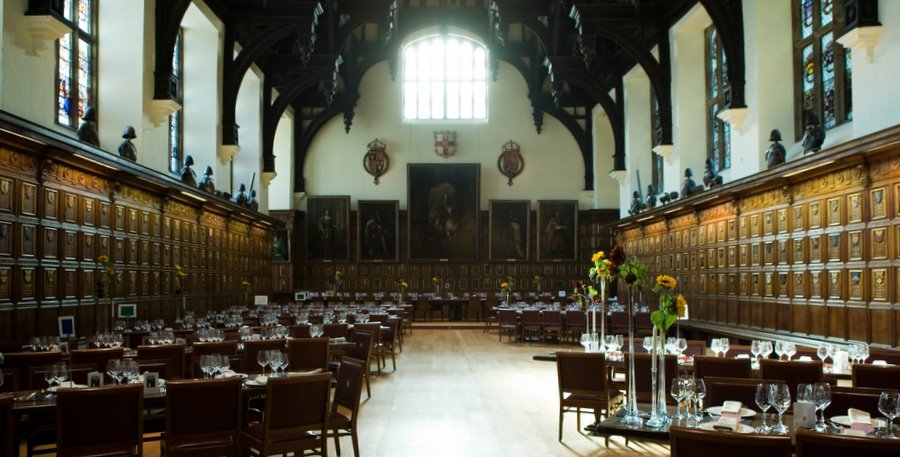
There are parts of London that are reeking, dripping in history. Everyone knows that, which is why they go in such numbers to the Tower of London, where actors dressed as 17th-century peasants point them in the direction of the gift shop. But there are quieter corners, barely less impressive, that are seen by few. Even after the Da Vinci Code pointed a certain type of tourist towards the Temple Church, not many make make it to Middle Temple Hall, just a few yards away. It’s an incredible place, so long as you’re not afraid of a little wood panelling, where the earliest known performance of Twelfth Night took place in 1602, with a certain William Shakespeare among the cast.

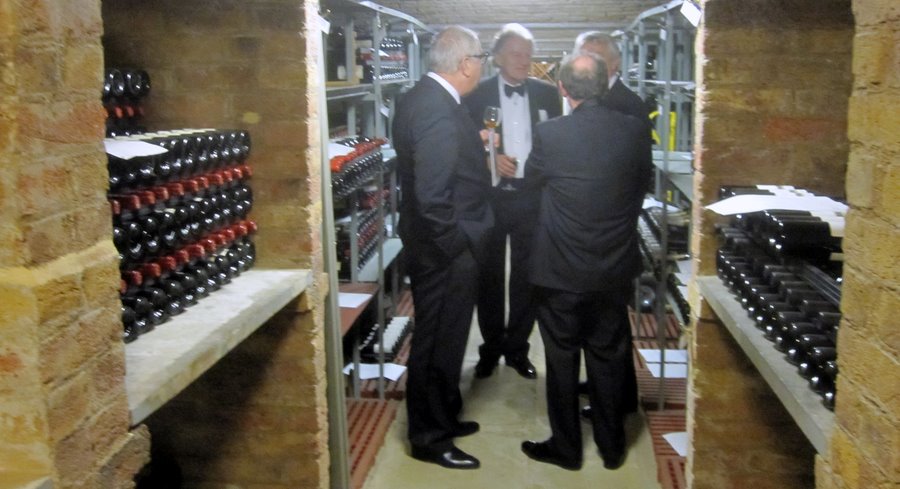
But a certain group of London lawyers, including as it happens my father, go there all the time. And recently I got to have dinner with them. And after dinner, I got to poke around their wine cellar.

To tell the truth, the cellar bit was rather disappointing. I thought they would have acres of subterranean caves full of three centuries’ worth of first-growth Bordeaux, but that stuff must be kept somewhere else. What they did have is a single corridor full of lesser Bordeaux classifications – Chateau Figeac, which I’ve always liked for mainly typographical reasons, seemed pretty popular –  some interlopers from the Rhone and quite a lot of Kiwi sauvignon and cheap viognier from the Languedoc.

The actual food was pretty decent, given that they were catering for a large hall full of hungry lawyers and their guests. The wine, at least on my table, was excellent. Most of them room got the house wines, with optional upgrades. The top table, full of important people such as, on this evening, the home secretary, and myself, gets the good stuff. Very good stuff: some Champagne in a side-room to kick things off, Ataraxia Chardonnay 2008 with the scallops (really liked this, and it’s a bargain at £12.50 a bottle if bought by the case from Wine Direct right now), Chateau Beycheville 1998, a fourth growth that’s in rather a different league to what I’m used to having with my dinner, and was impressively fresh and fruitsome for all its dozen years, with the (sadly overcooked) lamb, 2001 Chateau Filhot, a Sauternes deuxieme cru, with pudding and Taylor’s 1994 vintage port, or cognac if you prefer, with cheese.

I don’t believe this is what they have with dinner every day, with guest nights such as this one happening just once a term. But it was stellar stuff. Here’s hoping for another invite…

Very Pleasant indeed, thanks

As an obsessive reader of words, particularly in cases where at least one of them promises to be “wine”, I get through a lot of wine reviews. Despite this quantity I have a habit of remembering, at least for a little while, the names of things that get enthusiastically recommended. And if I see the same wine recommended twice in quick succession, I’m considerably less likely to forget it.

(Indeed, if anything sticks in my mind more than phrases I see recurring in tasting notes, it’s phrases I’ve never seen in them before: yesterday I read someone saying a Cote-Rotie tasted like “soapy blue fruits”. For a start, what fruits are blue? Blueberries, basically. Figs can be blue, I suppose, in a slightly purpley way. That’s about it. But blueberries and figs don’t taste anything like each other, particularly when they’re soapy I’d have thought. So which are you referring to? And did you really need to clean them so thoroughly?)

Anyway, here’s a few recommendations I remembered seeing recently:

Tim Atkin2005 McWilliams, Mount Pleasant “Elizabeth” Semillon, Hunter Valley Break a leg if you have to run to Majestic to get hold of this mature Hunter Semillon: light, yet toasty with fresh acidity and notes of citrus peel, herbs and lemon meringue. 93 points

Then, Victoria Moore in the Telegraph picking her best festive wines:  1. McWilliam’s Mount Pleasant Elizabeth Sémillon 2005 Australia There is simply no better white to sip with hot smoked salmon … Shot through with inflections of preserved lemons and hay, this unoaked sémillon takes on a toasty note as it ages that weaves around the smoky fish. Superb, at an extraordinary price.

Finally, wine writer and blogger Sarah Ahmed, aka The Wine Detective: It gives me great pleasure to give you the heads up on a stunning Semillon bargain  – as of today, Sainsburys are stocking a new, limited parcel of McWilliams Mount Pleasant Elizabeth Semillon 2005 priced at only £8.99.  At any rate, (and most definitely at this rate!) it’s a snip for a wine of this class, not least in this outstanding vintage.

All of which has got to make this possibly the most popular supermarket wine in Britain at the moment. What’s more, they were all getting excited when this wine cost £9.99 at Majestic, or £8.99 at Sainsbury’s. But in Sainsbury’s ongoing (until Friday) 25% off six bottles or more offer, that comes down to £6.74. At which this creamy, zingy little vixen becomes even less resistible, offering genuinely astonishing value for money. While you’re there, the Ravenswood Lodi Old Vine Zinfandel, a welcoming embrace of calming wintry redness, is on special at £6.99, which becomes £5.24 if you’re buying six or more. My final Sainsbury’s tip is a Yali Three Lagoons Carmenere, on special offer at £7.49 from £9.99, which becomes £5.62 in the deal – a sensual if not particularly thought-provoking red from a reliable and eco-friendly Chilean producer (not so eco-friendly, though, that they don’t use fairly heavy-duty bottles for their top-level wines). So what are you waiting for? Get on your bike, unless you’re off your trolley.

Further adventures with Naked Wines

A couple of weeks back I went to a competitive blind wine tasting organised jointly by Naked Wines and Findwine, another relative newcomer to the online wine retailing scene, and attended by a handful of bloggers as well as staff and customers of both companies. Fifteen pairs of wines were judged head-to-head, with Naked winning the majority of the battles. This was hardly a surprise.

I had a good chat with their founder, Rowan Gormley, who said you could normally tell the difference between one of their wines and a Findwine offering (or pretty much any other wine retailer’s), because theirs were chosen by customers and their rivals’ were chosen by wine experts. So theirs might lack a little complexity, they might not be enormously challenging or thought-provoking, but they are immediately pleasurable. As Jordan’s success proves, the British public are frequently happy to prioritise the superficially appealing over greater depth and profundity and as it is with large-breasted celebrities, so it is with wine.

The fact that they win competitions like this doesn’t mean their selection of wines is necessarily better overall than Findwines’, or anyone else’s (there’ll be more about some crackers from Findwines next week, in fact). It is just different. How different they are only became apparent once I talked to a couple of their customers, selected from their keenest members – archangels, in NW terminology. The archangels are NW’s Robert Parkers and IWSCs and Decanters, all rolled into one. Their opinion rules. A selection of them get sent, for free, pretty much every new wine the company are considering adding to their list; anything that doesn’t wine go down well gets dumped.

This means that even new wines are launched with plenty of positive customer feedback, ready to encourage others to partake. Online, customers discuss the wines with each other, and often with the winemakers too. So if you talk to an archangel, they’ll refer to their favourite wines not by what it says on the label, but by the winemaker’s first name. In this way NW are, I think, enthusing people about wine in a different, more relevant, less stuffy and rather original way. And it’s enthusing them quite a lot: their most expensive offering is a wallet-frightening £32.99. All of which doesn’t make NW perfect, far from it, but it does make them quite exciting.

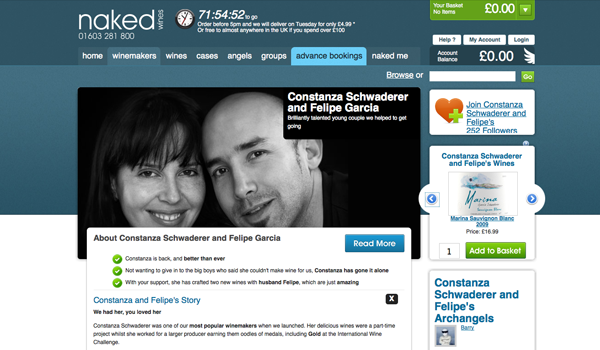
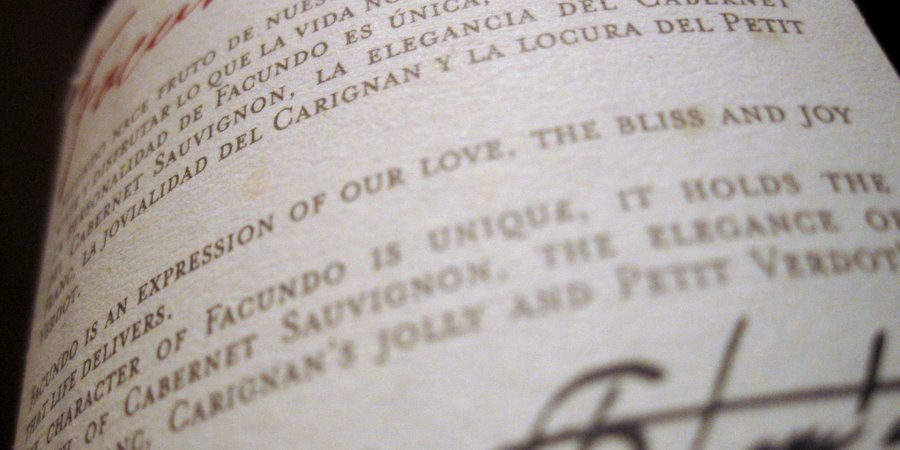
While I’m on the subject of NW, the other night I tried a wine called Facundo, made by the happy couple pictured on their website at the top of this post. The contents of the bottle are pretty special, given that they are not merely a fairly pleasing alcoholic beverage, but a quite detailed expression of the pair’s mutual adoration.  “Facundo is an expression of our love, the bliss and joy that life delivers,” reads the back label. “The character of Facundo is unique. It holds the strength of cabernet sauvignon, the elegance of cabernet franc, carignan’s jolly and petit verdot’s folly.” Eh? What happened to saying it with flowers?

I guess there’s something apt about celebrating the union of two people by blending grapes, though their choice of not two but four different varietals suggests theirs might be a more open marriage than some. Good wine, though. A bit straight-laced upon opening, but much better for a bit of time in glass/decanter. Once it had pulled off its tie, unbuttoned its shirt and is slouched a little bit on the sofa, Facundo proved a genial companion for an evening that certainly ended with me slouched on the sofa. Good choice, archangels.

Guest blog: Casillero del Diablo – The Devil’s Cellar

Concha y Toro is an enormous operation. I’m just looking through their latest accounts, and in the last audited quarter alone – the third quarter of 2010, just three measly months – they exported 5,999,050 cases of wine from Chile. That’s a few shy of 72 million bottles. Their UK subsidiary reported year-on-year sales rising by a vertiginous 52.6%, “due to improving sales of Casillero del Diablo, Isla Negra Reserves, Viña Maipo & Palo Alto, and as a result of securing new promotional activities in the Off Trade sector”. That’s one heck of an improvement. But evidence of these promotional activities is not hard to find. As you can see from the ad above, Casillero del Diablo now sponsor Manchester United, and are involved in next month’s masters tennis (that’s old players who aren’t up to playing on the main tour any more but still fancy the occasional pay-day) at the Royal Albert Hall. They also, a few weeks ago, generously took Gilad, a friend of CF’s, out for dinner with their chief winemaker, Marcelo Papa. And this is what he wrote about it…

What sort of wines would you expect to find in the devil’s cellar? Wine aficionados might expect it to be full of the kind of mass-produced swill that we are used to finding on our supermarket shelves. And, in a way, they’d be right.

Casillero del Diablo (literally, the devil’s cellar) is part of the Concha y Toro Chilean wine dynasty. Established in Chile in 1841 by Don Melchor and named after the rumour he circulated, in a bid to keep strangers away from his reserve, that the devil lived in his basement, it’s now a very familiar name in the UK. If you live in a British city, there is probably a bottle for sale within 500 yards of you right now.

This has been a good period for Chilean wine sellers in the UK. Retailers have been reporting a sharp increase in sales as sentimental buyers showed solidarity with (and raised a glass to) the 33 rescued miners. The drama of their rescue has supposedly put Chile on the world map but, in the wine world, Casillero were very much there already.

Mega brands of Casillero’s ilk (huge houses, producing huge volumes at low prices) are often regarded by wine lovers as the devils of the wine world. Yet Casillero has escaped that curse, enjoying a fine reputation for pleasing wines at very pleasing prices. At dinner with Marcelo Papa, Casillero’s affable head winemaker, Marcelo was quick to remind us that the wines from Casillero’s 8,000 hectares of land have landed an impressive tally of 80 international awards (including 8 gold and 18 silver). “Our owners make wine and don’t make anything else,” Marcelo opined. “That makes a big difference. And we’re particularly discerning about our varietals and suppliers. Not everyone is.” His point is, put simply, that the devil’s in the detail.

Dinner with Marcelo was hosted at the homely Gauthier restaurant in Soho, a charming venue but perhaps not the most fitting for Casillero. My selection of an eatery equivalent to Casillero’s wines would be Nandos – reasonably priced, easy to find and surprisingly tasty – but I was glad Marcelo selected differently.

Casillero’s signature is solid single-variety wines at competitive prices. Their sauvignon blanc is a case in point. The Casablanca Sauvingon Blanc 2009 (rrp £7.49) is a seriously zesty and citrusy number, pleasingly sharp yet refreshing and comparing favourably with similarly styled (but slightly pricier) kiwi sauvignon. It may be in shorter supply next year; February’s earthquake in Chile was a “disaster”, Marcelo sighed, for sauvignon.

Marcelo worked us through his range with vigour. Carmenere, Chile’s signature red grape, made a more than capable companion for mallard and the Reserva Privada Cabernet Syrah 2007 (a departure from Casillero’s usual single variety wines) was an interesting match with a cheesy Feuillete of Fourme D’Ambert, providing rich and deep berry flavours.

Perhaps most interesting of all though was Marcelo’s “battle of the Chardonnays”, when two wines he has crafted from the world’s most popular white grape went head to head. The CDD Casablanca Chardonnay 2009 was fairly fruity with a rich palate and pleasant finish, but it was clearly overshadowed by the evening’s most intriguing offering, the Maycas del Limarí Quebrada Seca 2007 (not a Casillero-labelled wine but from another Concho Y Toro’s winery overseen by Papa). With a remarkable nose – the whiff of heather in a summery meadow coming to mind – the wine oozes minerals with a clean dry finish and a surprising (yet welcome) lack of obvious wood for a wine that spent 14 months aging in French oak barrels. 300,000 cases of the Casablanca Chardonnay were produced but just 500 of the Quebrada Seca.

So, small really is beautiful. But I didn’t seek Marcelo’s comment on that. As chief winemaker for both the giant Casillero and the diminutive Limari, he really is between the devil and the deep blue sea on that one.

Other alcoholic beverages are available

One of the great things about wine is its ability to work with food, to create a harmonious symphony, or indeed a discordant thrum, of flavour and aroma that neither of them on their own could match. Having said that, matching food and wine has never been a particular obsession of mine – with overwhelming frequency, what I fancy eating tends to pair pretty successfully with what I fancy drinking, and if it doesn’t I’m pretty happy just to stop drinking until I’ve finished my dinner. My basic equation is good food + good wine + good company = a good evening, but that’s forgetting the fact that other alcoholic beverages are available.

There’s beer, of course. Matching beer and food is nothing new, and if done well is no less successful than wine (and quite a bit cheaper). I was memorably introduced to the concept a few years ago at the Norrebro Bryghus, a microbrewery and restaurant in Copenhagen (a coffee stout of theirs still lingers in the memory). Cider’s an option, at a push. Some cocktails could work. But I’ve always drawn the line at neat spirits. They’ve got their place – with a mixer or after a meal, basically – but on their own, straight, they’re so alcoholic they don’t so just exercise the palate, they annihilate it.

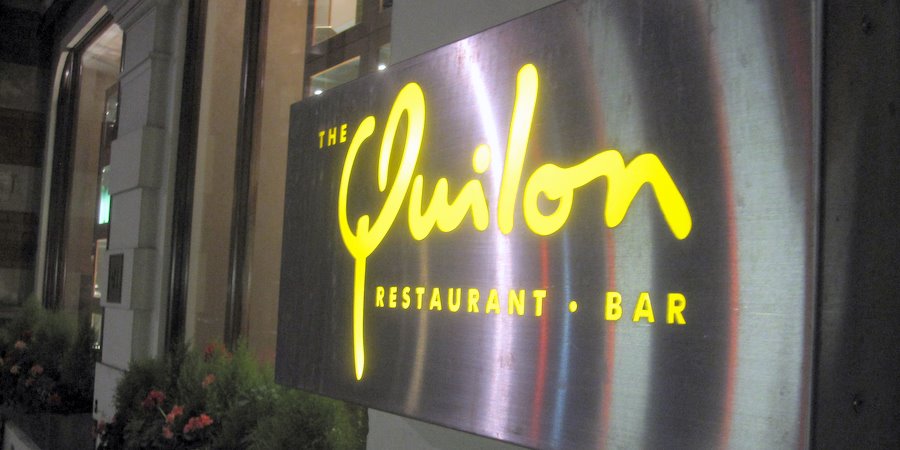
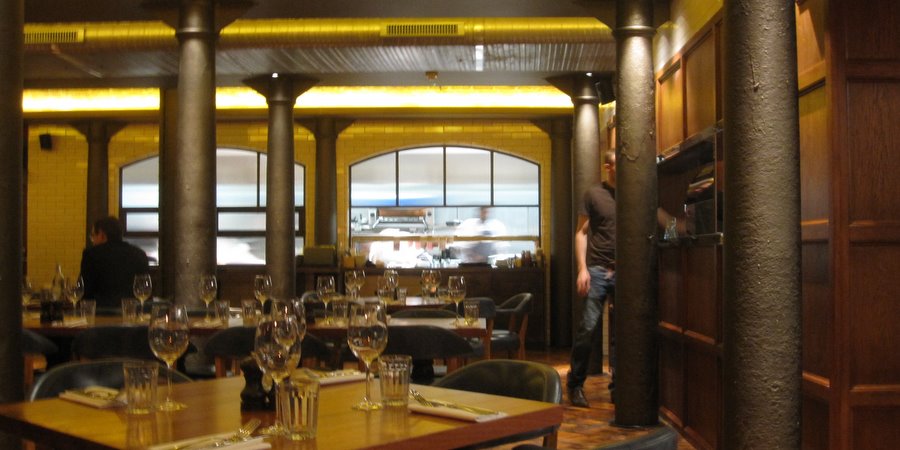
But as ever I’m willing to put my body (mouth and liver, mainly) on the line in the name of research. And so it was that I went to the Indian restaurant Quilon recently, for a whisky-based dinner. As well as a Michelin star, they’ve already got a beer-matching menu and in the new year will add a whisky-matching menu to the list, and just to prove how seriously they take the subject they’ll also host a one-off dinner in February with Dominic Roskrow, somewhat obsessive author of The World’s Best Whiskies and editor of Whiskeria, in house magazine of The Whisky Shop. He’s done so much for bourbon he was recently appointed a Kentucky Colonel, and is so hot on Scotch he’s been made a Keeper of the Quaich.

By way of warm-up, Roscrow also hosted my dinner, presenting four whiskies which were all dealt with before the meal arrived, so the focus of the evening wasn’t exactly on matching them with the food. He played his role well –  clearly he takes whisky seriously, but he doesn’t think that everyone has to. His choices were good: varied, interesting and, in some cases, delicious (if anyone has a spare bottle of Henry McKenna Single Barrel Bourbon to hand, just send it right over), but a couple of them nudged towards a heady 60% abv, not really suitable for drinking with anything other than water, quite a bit of it, both in the same glass and in others.

We were invited to keep drinking the whiskies once the food came, but frankly my glasses were empty by then, and some wine had arrived. Dinner, incidentally, was excellent. Almost no cream or butter is used, the chef Sriram Aylur suggesting that most diners should be healthier when they leave than they were when they arrived. That doesn’t mean that he’s in charge of a glorified WeightWatchers bootcamp, mind, just that you’re guaranteed to avoid the oil-slick-surfaced curries familiar from the British high-street. It’s excellent stuff, but I’m still a bit bewildered by its Michelin star – Aylur doesn’t just skip on the dairy, but also on the cheffy flim-flam that the Michelin inspectors tend to be so keen on. Our pudding was fruit salad. Sure, it came with a wonderful black pepper ice cream, but I never realised you could get a Michelin star for taking a grape off its stalk and chopping up a pineapple.

The evening was a qualified success. I have resolved to give whisky more of my time (but not necessarily more of my mealtime), and to return to Quilon at some point without downing four glasses of 60% proof alcohol and a cocktail before dinner. I am a bit sad, though, that I never found out precisely where Roskrow keeps his Quaich.

CF went to the whisky dinner as a guest of Quilon. Their next whisky dinner with Dominic Roskrow will be held on Monday 1 February 2011. Just 16 tickets are available, priced at £59.50 per person, and include a whisky cocktail, a tutored tasting of four super-premium whiskies, three-course dinner and service. For reservations call Quilon 020 7821 1899.

Hawskmoor Seven Dials: They’ve got the spirit

Everyone in London knows about the new Covent Garden outpost of Hawskmoor. Most of the world’s food bloggers seem to have made it during their soft opening, when the food was at half price – some of them several times. Everyone agrees: it’s amazing. It looks great, the food’s impeccable and the service (relatively easy to get right during the soft opening, to be fair) above reproach. The only downside of going when the food’s half-price is that you end up ordering something twice as expensive as anything you’d ordinarily go for. So it was with me, and the half-kilo chateaubriand that came my way. Unbelievably good – quite possibly the finest protein-consuming experience of my lifetime – but at £60 before the discount also crazily expensive.

Steak, composed as it is entirely of expensive meat and not at all of cheap vegetables, represents the worst value in restaurantland. When you can get a three-course set lunch at either of the capital’s three-Michelin-starred restaurants for £45, with amuse-bouches, pre-desserts and wine if you’re lucky, spending that-and-a-half on a main course (and that’s without chips) is the behaviour of a total loon. But standard steaks cost a shade under £30 and are probably amazing enough to be worth a very occasional splurge if you’re in the area, and the kimchi burger on the bar menu is already famous (seems strange to me: I’ve been to Korea, the home of kimchi, and the stuff is utterly revolting).

In the corner of the dining room, behind glass but very much on view, are the wines. They’ve got a good list, though you’ll need to spend upwards of £40 if you want a particularly wide selection (there were two choices under £20, eight between £20 and £30, seven between £30 and £40, and then the action starts to hot up). But my problem with the wine list is that it isn’t the spirits list, and the spirits list is amazing.

Both lists highlight a few items for special attention. On the wine front, they pick out “our current favourite reds”, and then tell us at length how good everyone thinks they are. There’s an Alban Vineyards syrah which Robert Parker once rated at 100 points, “alongside some of the finest tipples on the planet”. There’s a Sine Qua Non grenache, which is “an extremely rare chance to taste” a wine which “scored as high as 100 points in the Wine Advocate”. There’s offerings from Vega Sicilia – “their wines are some of the finest in the world”; Henri Jayer – “amongst the most sought-after, rarest and most expensive wines in the world” – and Michele Satta – “his wines consistently feature amongst the top wines in the world”.

You see the theme. The point of these descriptions seem to be to assure the fat-walleted folk considering trying one of these featured wines that they’re making a great decision, one that Robert Parker would agree with. But it’s hard to warm to their style. It’s selling me the wine, not telling me about it.

Then, along with the desert menu, comes the spirits list. In each subsection, one offering is singled out – not necessarily the most expensive, just one they particularly like, or that they’ve got a good story about. A grappa made in a cave in some bloke’s garden, with every label individually painted by said bloke’s fair hand; a tequila which (not totally uniquely, but remarkably all the same) on its third distillation passes vaporously through the carcass of a dead, uncooked chicken, which at the end of the process is removed, shrivelled and probably fairly alcoholic, and buried in the family shrine, and more of the same. Evocative descriptions that double as conversation starters – handily, as tables might be running out of things to say to each other by that stage in proceedings. It is quite possibly the best menu I’ve ever read.

And thus I left full and happy, but for the slight disappointment that whoever put together the wine list seems to lack the gift for storytelling that makes his spirit-compiling colleague such an absolute hero.

The WSET advanced course: some thunks

This blog first appeared on the website of Harpers Wine & Spirit, the trade magazine of the British drinks industry, earlier this week.

Attempting the WSET advanced course in a single week requires a fair amount of single-mindedness and dedication, involving as it does four and a half packed days of classroom study and a recommendation that students spend a further 80 hours of their own time on preparation and revision. It suits a young insomniac with no family, even fewer friends, and a concentration span so monumentally impressive even Ribena is jealous of how concentrated they are.

I am none of those things. I have two young children and an almost complete inability to do any one thing for more than about eight minutes without checking my emails or seeing if the Waitrose wine sale has started yet. But I had invested my own money in course fees and booked a week’s holiday, and I was determined to waste neither. I spent two full days and several snatched hours in libraries before the course began, lifting facts from the textbook and gleefully stuffing them into my brain, like a taxidermist with a bumper bag of cotton wool and a recently deceased squirrel.

Despite this effort, which I must admit fell some way short of the suggested 80 hours, I entered the course with a good chunk of the book unread and a realisation that at least some of the facts that I so recently stuffed into my brain had already fallen out again. The situation might have been rescuable had I been able to spend the entire week in a wine-focused trance, but instead I was racing out of the classroom at 4.30 to pick the kids up from nursery, tucking them up in bed three hours later and then settling down to see how Spurs were getting on in Europe.

Anyone who’s studied a foreign language has probably experienced the feeling of frustration you get when you return to the country where it’s spoken after a long absence, and spend several days blundering about half-wittedly saying nothing more complicated than “deux pains-au-chocolat s’il vous plait”. Eventually, with any luck, it all starts flooding back, but by then nobody at the boulangerie is willing to speak to you at all. So it is with sports journalism, only accelerated. So much as a week of ignorance and you’re basically useless, at least until a week’s worth of other stuff has happened to replace what you missed.

Plus there was the 850-world column about the week’s sport on TV that I had to file a little over 24 hours after the end of the course. I didn’t actually watch much sport on TV that week, preferring a rather scattergun approach to time-shifting, though I did spent quite some time trying to decide precisely which programmes’ times I should shift. All of which further reduced the amount of homework that got done.

The course itself was enjoyable in most part, though a little too focused on the accumulation of facts. Some of them have lodged in my mind, others enjoyed only fleeting visits. A great deal of time was spent telling me what soil types are prevalent in different areas, but however hard I tried I simply couldn’t convince my brain that it was interesting enough to remember. Subconsciously I just couldn’t give a schist.

I got the feeling that a beautiful, rounded, plump, possibly slightly big-bottomed two-week course had been crash-dieted until just skin, bone and five rather uncuddly days remained. For good reason – who’s got a whole fortnight to spend on a wine course, after all – but to its detriment all the same. The new world sped by in a day; New Zealand got a scant half-hour. But spirits, no more than a passing interest for anyone on the course, gets a session of its own, so far as I could tell simply to avoid offending a letter in an acronym.

I enjoyed and learned a lot from the tutored tastings, and was impressed both by the general standard of teaching and the distance people were prepared to travel in order to benefit from it. But I yearn for a course that relaxes and revels in each chosen area even if it means leaving others out entirely, for a week spent (figuratively) in slippers rather than running shoes. The sprint ends on Friday afternoon with an exam – 50 multiple-choice questions, a few longer written answers and a couple of wines tasted blind – by which time we are expected to know, more or less, about the entire world and everything in it.

By the end of the course I have managed to read my entire textbook, but for a few chapters about obscure areas like Bulgaria, Greece and (perhaps more of an oversight, this one) the USA. But I am a jack of all regions and a master of none; as I leave I’m aware that the areas I know most about are still the ones I knew before I arrived, the ones I have learned about in my own way, by drinking and reading and meeting and speaking. It’s not the most efficient way to study, and it’ll take a lot more than five days to finish the course, but this is how my wine education will continue: one glass at a time.

News and reviews

It’s been a fortnight since my last post, but it’s all right – I’ve got excuses. Or rather one big excuse, in the shape of the WSET advanced course, which ate up the whole of last week and involved a lot a lot of nose-to-the-textbook graft and not a lot of fingers-to-the-keyboard downtime. More of that later, but in the meantime here’s something that I haven’t done for a while – genuine old-fashioned wine recommendations.

At some point, shortly after I realised that a few people were reading this blog who weren’t me, I decided to cut back on my wine reviews. Quite a long way back. Lots of other people are very good at reviewing wines, after all, and most of them taste a lot more of them than I do. But the fact is that I’ve tasted a lot of wines recently, and as you’ll soon see I’m not exactly sticking my neck out, so what the heck.

Achaval Ferrer Finca Mirador/Bella Vista/Altamira 2007

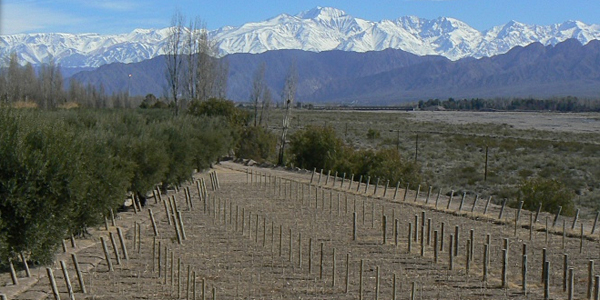
I’ve never had malbec this good before, and will be surprised and frankly delighted if I find anything better. I’m not sure they represent brilliant value for money – you can get a lot of wine for £50 – but they could be the answer if you’re looking for a meat-friendly big-hitter to splurge on and consider the imminentish start of the annual festival of officially-sanctioned Christmas-themed excess a decent excuse. The three single-vineyard wines are vinified identically, the sole difference being the terroir: Mirador from the Medrano Region is 2,400 feet above sea level, Bella Vista from the Perdriel District sits at 3,100 feet and Altamira (pictured above) from La Consulta tops the lot at 3,400 feet. The fact-packed data sheets alone are intoxicating enough for the wine-obsessive anorak, but the drinks speak loudly enough on their own. Bella Vista produces the darkest, fullest, most harmonious wine of the three, but margins are extremely tight. At £51.99 a bottle it’s not for the faint of heart or wallet, though I’m happy to say that the Quimera, a blend of 38% Malbec, 24% Cabernet Sauvignon, 24% Merlot and 14% Cabernet Franc that comes in at a relatively bargainous £23.99, is another blackfruited beauty and that Oz Clarke (see below) considers their basic malbec, at just £13.99, the 58th-best wine for 2011. (All will be sold at some point by Corney and Barrow, though they’ve only got the cheaper two listed online at the moment)

Juliénas, Esprit de Marius Sangouard, Trenel, 2009

At under a tenner this is excellent value. Everone’s very excited about this vintage in Beaujolais, and though I don’t honestly know enough about previous ones to comment I think this is worth £9.50 of anyone’s money (from The Wine Society). Of all the wines I tasted on last week’s course (18 a day with a few bonus extras, so a little shy of 100), some of which really were very good indeed, this one stuck out with its particularly high reading on the valueformoneyometer. It’s got all the black cherry juiciness that you’d expect and there’s enough going on to convince our class at least that it could benefit from further ageing.

Book review: Oz Clarke 250 Best Wines 2011

Basically an expanded, glorified newspaper wine column, full of things I will probably never try however much Oz likes them. It’s not that I don’t trust his judgement, it’s just a bit impractical. I’m not sure what to do with all this information he’s giving me. It might help if the wines were indexed by retailer, so if I were heading for Majestic, say, or about to put an order in with the Wine Society, I could quickly and easily see which of their wines Oz considers worth checking out while I’m at it. As it is, it’s just a list of wines with tasting notes. Do people really buy this book and then just hunt down the entries wherever they are, like bounty-hunters chasing fugitives? Surely enjoying wine involves a certain amount of experimentation and exploration, rather than slavish dedication to a glorified shopping list?

There is, to be fair, more to this book than that, with bonus sections on how to drink, store and buy wine and a very good directory of retailers, listed alphabetically and by region, with a short summary of their particular strengths. And hard as it may be to find a genuine practical use for the list of 250 wines that makes up the meat of the book (though someone’s got to find it useful: after all these years you’d imagine his publishers would have worked it out by now if nobody’s buying it) the enterprise is even harder to dislike: Oz writes clearly and, most importantly and impressively, without pretension, and makes interesting choices clearly without tokenism – there are four Tim Adams wines in his overall top 20, including the No1, a situation so ludicrous and avoidable it can only have come about through genuine enthusiasm. I can’t really encourage you to buy it, but I’d certainly suggest you flick through it next time you’re in a bookshop.