Newspaper wine columns: another one bites the dust

When The Guardian and The Observer allowed wine writers to write

When The Guardian and The Observer allowed wine writers to write … columns by Malcolm Gluck and Tim Atkin from 2004.

This week the wine columnist on the London Evening Standard, Andrew Neather, wrote his last column, and another nail was grimly hammered into the creaking coffin that is bulging full of discontinued or horribly diminished wine columns in the British media.

Take the newspaper(s) I work for. Not that long ago, The Guardian was handing over 900 words in their Weekend magazine to Malcolm Gluck’s then-popular Super Plonk column. At the same time Tim Atkin got between 500 and 800 weekly words in the Observer, and not far off a thousand in their monthly foodie special OFM. Now The Guardian gives Fiona Beckett 400 words, which makes is spectacularly hard to write anything interesting if you’ve also got to recommend and briefly describe half a dozen wines. What’s left is a couple of paragraphs of actual writing, followed by a very slightly glorified shopping list. How The Observer’s David Williams must pine even for that – he’s got an unglorified one, consisting of one short paragraph on each of three wines, a sum total of 200ish words.

Newspaper editors might not like wine very much, but (as a rule) they aren’t idiots, and they no longer rely on mere hunches to make their decisions. Changes to national papers are focus-grouped to oblivion before they’re allowed anywhere near the street, and presumably the focus groups haven’t contained many more wine nuts than the average editor’s office. But there is a problem in the journalists’ logic here: if big wine columns are a waste of space because only a few ultra-committed drinkers are interested in them, short wine columns are a bigger waste of space because not even the ultra-committed drinkers are interested in them.

Food writing is massively popular at present, but that is at least in part because writers are given space to make it interesting. If Nigel Slater wants to tell us about lasagne, he can write a meandering 500 word introduction and follow that with a detailed recipe. If he lived in wine-writer-world, he’d be ordered to concentrate on supermarket produce and given so little space what you’d end up with is: “Tesco’s Finest lasagne is OK, but I prefer the one from Waitrose, which is on promotion this week at £2.49.” With such tight constraints, what’s needed isn’t a writer, it’s a magician.

With the honourable exceptions of the Telegraph and the Financial Times, where Victoria Moore and Jancis Robinson are allowed enough space to be interesting, the national press is failing wine fans and the trend is horribly downhill. But it’s still hard to understand precisely why.

Given the size of weekend papers, and the number of words they devote to news about nothing, interviews with nobodies and random columnists detailing the hilarious thing that they saw in their sock drawer the other day, I’m continually flummoxed by their refusal to give any attention to wine. They may say that wine columns are boring and no one reads them, but I would argue that it is shopping lists that are boring and they could do with honing the concept. Any publication that works out how to show me the beautiful scenery and introduce me to the fascinating characters that I have seen and met on those sadly rare occasions when I visit winegrowing areas will gain at least one new reader, and I suspect many more.

Sylvaner, the forgotten grape

This evening, for the first time, I have actually opened a bottle of sylvaner. And, you know what? It’s really good. Just like every other bottle of sylvaner I’ve ever tried – about half a dozen – has been really good. This is a grape which deserves to grace my table on a more than once-a-decade basis. Sure, it’s better known for producing character-free alcohol-water than quality wine, but is that reason enough for its obscurity? After all, it’s hardly harmed pinot grigio, has it?

Jancis Robinson is about to publish her guide to every grape variety she and her grape-loving chums could identify – 1,368 of the little blighters – yet even a promiscuous drinker in a country with perhaps the most open, acquisitive wine trade of them all gets largely stuck on the same dozen or so. Without actually having anything as advanced as a genuine statistic, I’d be willing to wager that two dozen grape varieties are responsible for 98% or more of Britain’s vinous intake. However much pleasure and variety that small selection provides, how much more could the remaining 1,344 contribute?

Before tonight, my limited experience of sylvaner has all come in a brief visit to the maverick Reinhessen sylvaner obsessive Michael Teschke (a revelation, and impressive enough for me to bring home a couple of bottles, still unopened, of his older wines – that’s right, this wine can age). This is a man memorable primarily not for growing and loving the really quite obscure blue sylvaner (a grape whose main benefit is that it reminds me of an often-forgotten Erasure hit, though it must be said that I drink it even less often than I do not-blue sylvaner, which is to say, never), nor even for pulling off a middle-aged male ponytale, but for wearing sandals even in winter because “feet need to breathe”.

There’ll be more about him at some point, when I actually open his wines. In the meantime, back to tonight. Here are some more numbers: out of 3,176 wines listed at the moment on The Wine Society website, two are 100% sylvaners, one costing £7.50 and the other £7.95 (this one came from them, part of a mystery mixed case – which is a wine merchant’s way of saying that nobody wanted to buy it when they knew what it was). Berry Brothers sell 5,615 wines and again just two are sylvaners, and one of those is being sold en primeur so you can’t actually have it. Slurp’s 4,215-strong list contains one, and winedirect has precisely that number among their 7,360 offerings. It’s not just me who isn’t giving this grape very much attention.

We’re all missing out. It may be that it takes an exceptional producer to make a truly memorably sylvaner, but that might either be the cause of the grape’s obscurity, or the symptom (in other words, if we bought more of it, perhaps more producers would put more effort into making it taste good). But on the plus side, even the good stuff is cheap: sylvaner even from classy producers who take it seriously, such as Bruno Sorg and Domaine Ostertag in Alsace, costs little more than a tenner a bottle.

This one is from an area less well-known for making this less well-known grape: the Alto Adige, in Italy but close enough to Austria for German to be their first language. Köfererhof have just five hectares of vines, which are cultivated organically (don’t ask Teschke what he thinks about that, incidentally). At six years old it has a deep golden colour and gentle acidity, and whispers softly of grapefruit and green mango. Scrummy, and what’s more Mrs CF agrees. Sadly winesearcher suggests that nobody is selling Köfererhof’s wines in the UK any more, but I’m already working on an Alsatian order – It seems I’m just a sucker for sylvaner. I’m sure others would be too, if they ever got a chance to try it.

Goodbye, old friend

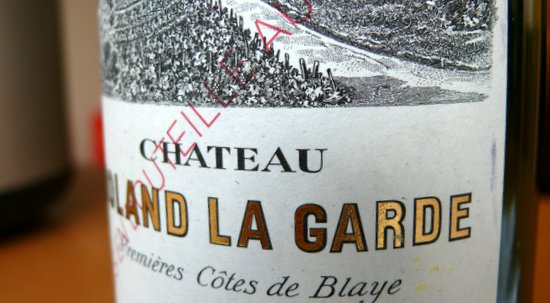
Chateau Roland La Garde 2005

Four years, three months, two weeks and a single day ago, I bought a case of wine. Yesterday I finished the final bottle. There’s something about the change in wine, its evolution and its ageing, that sets it apart from other comestibles. Everything else that you buy to put in your mouth is designed to be at its best when it leaves the shop. Except “ripen at home” pears. And they’re only ever with you for a couple of weeks, before you realised they’ve over-ripened at home and have to throw them out.

Much wine is exactly the same, best consumed young and fresh. Some, though, alters and improves as the years go by, and this is one of them. At some point, inevitably, they stop improving and start getting worse. This is one of those, too. This bottle is certainly not the best I’ve had – to my tastes, it peaked about a year ago – but that’s perhaps the best way to say goodbye. It would be sad to polish off a case while suspecting that every bottle had been drunk too early. While it’s also a little sad to drink a wine too late, this one only cost me £7.50 a bottle, the kind of uplifting price that makes it easy to cope with being a little downcast.

Chateau Roland La Garde, Premieres Cotes de Blaye 2005. Not a brilliant wine, but at its best an extremely enjoyable merlot-dominated blend from one of Bordeaux’s most unfashionable subzones, and always to be remembered as a significant marker on my personal wine path. This was the first wine I bought a full case of, a low-cost introduction to a different and less immediate kind of wine appreciation. There have been several more since, some whose progress I have only just started to chart and others stored elsewhere which I don’t even intend to introduce myself to for years yet. Somewhere, in some cases many miles from here, they are quietly sleeping, waiting. I can only hope that I choose something close to the right time to wake them up.

I enjoyed the years Roland and I spent together, and look forward to achieving similar levels of intimacy with others in the future. What we shared was a very different and almost certainly superior kind of wine appreciation to that experienced when you pop to an offy, grab a bottle, take it home and drink it, however good that bottle is. But I remain bemused that an inability to properly enjoy a wine for years, sometimes decades, after purchase is seen as such a positive attribute; how customers managed to be convinced that being caused considerable hassle and expense was somehow to be welcomed. It seems like a rum old business to me.

Madeira, and a journey into prehistory

20120912-215157.jpg

You’ll have to bear with me here, as I’m about to explain a concept which is mildly complicated and will, once grasped, prove of absolutely no use to you for the remainder of your life. It is something I would call “aggregate vintage”.

Let’s say you drink two wines one evening. One is from 2007, and the other from 2009. It is currently 2012, so one wine is five years old, and the other three years old. Combine them and you have eight years of wine age, giving your evening’s drinking an aggregate vintage of 2004. Perhaps, for the sake of argument, you might try a few mature Bordeaux over an night, say one from 1982, one from 1983 and one from 1991. So one is 30 years old, one 29 and one 21, making for a total age of 80 and giving an aggregate vintage of 1942. That’s the idea. See, it wasn’t so complicated.

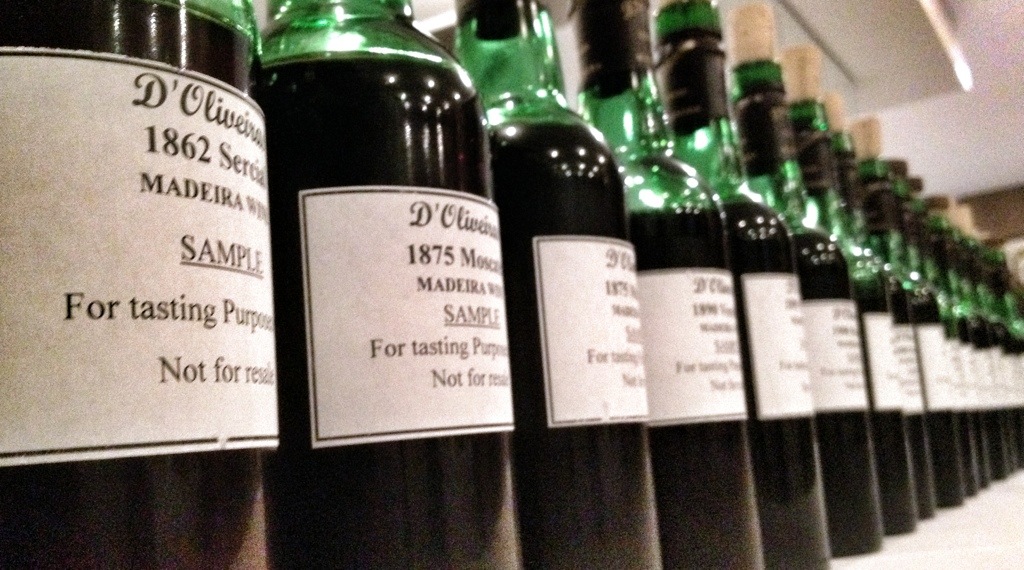
One night, just before my Olympic lockdown, I spent a few hours tasting wines from Madeira. You can see some of the bottles I tried that night above – you’ll notice that the one nearest the camera dates from 1862, the year after Charles Dickens wrote Great Expectations and the year before Abraham Lincoln delivered the Gettysburg Address. It was not the oldest wine there.

I tried a total of 40 wines, of which 32 had a stated age or vintage. Some of them were pretty young: a 2001, a couple of 2000s, a handful from the 1990s. Others were very old, the oldest dating from 1850. Add up their ages, subtract from 2012 and you get the aggregate vintage: 320BC, closer to a time when woolly mammoths roamed the earth than it is to now.

Of course 40 wines is quite a lot, particularly when they’re pretty alcoholic. Towards the end, despite liberal use of a spittoon, my tasting notes became a little imprecise: “As above but with more toffee”, for example, or “very fecking good. Feeling a bit emotional”. So it was that the main thing I learned that night was respect for proper professional wine tasters.

All of these wines, and several more besides, had been sent to Neal Martin, newly-appointed Iberian supremo at the Wine Advocate, for adjudication. He had a little sup of each and decided that it would be a bit sad to tip the rest of them down the drain, so convened a small gathering of interested others to do them a bit more justice. He tasted all of those wines over a single afternoon and produced for each one of them a tasting note that makes sense, and a score that will be used to decide their market valuation. I could not do his job.

I was one of the early arrivals, and after standing about for a while waiting for the Madeira experts to arrive we decided that with so many wines to try and time passing pretty relentlessly, as it does, we might as well get cracking. So we poured ourselves a couple of little tasters: a 1996 Barbeito colheita, and an 1850 d’Oliveiras verdelho.

20120912-230717.jpg

I thought it was a brilliantly illuminating comparison, between a dense, sticky, intense old wine (above, left) and its younger, brighter, nutty younger relative (right) (I preferred the 1996). When the Madeira experts arrived, they were inevitably horrified at our choices. As Madeira is left to age in oak casks the water gradually evaporates, leaving an ever more intense liquid to be eventually bottled. After a century and a half this liquid is pretty damn intense; tasting it first did little to aid our ability to taste what followed. But I’m not an expert, and would happily have taken half a dozen contrasting pairs over 40 individual wines and learned a lot more from the process (though the aggregate vintage would have been less impressive).

For me, the great pleasure of really old wine is not the taste it offers (subject to certain minimum standards being met) but the thoughts it provokes. To hold in your mouth the juice of grapes which grew 150 years ago and more, to think about the time that has passed since, and the people who have lived and died, is quite humbling. At the end of the evening I took home a couple of not-quite-empty bottles, one from 1875, so I could give them the time and respect their great age demanded. It is an experience I will not quickly forget or, at about £750 a bottle, repeat.

Thursday night is wine night in Nimes

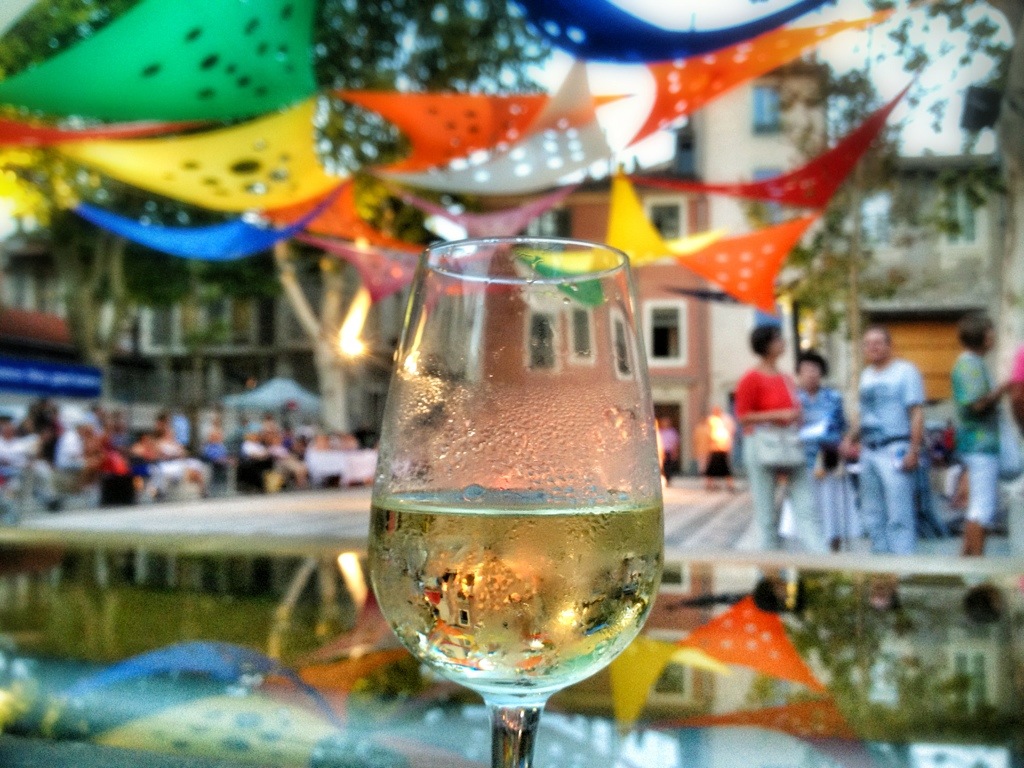
A glass of wine in a Nimes square

Hello! I’m back!

I won’t tell a lie, the last couple of months have been pretty hectic. Euro 2012, which was a pretty big deal at the time but you may have forgotten in all the sports-related excitement since, was followed in short order by the Olympics, which for a London-based sports journalist was a guarantee of extreme business. But being not just a sports journalist but a sports fan, I was determined to spend as much of my free time as possible during that two-week period gorging on live sporting action. Add to that the fact that our nursery decided that that very fortnight would be the best possible time to put their feet up for their annual summer closure, adding constant childcare to the things I had to arrange, and you’re left with a perfect storm of unprecedented business at home, work and play. Still, I survived, and what’s more so did the children, and I hauled myself to Olympic water polo, diving, hockey, swimming, track cycling, athletics, more athletics, even more athletics, synchronised swimming and yet more athletics. In the entire fortnight I was home for a single evening, and drunk a solitary glass of wine.

Five days after the closing ceremony I was off on holiday. Finally, I was going to have a little time to relax and, yes, perhaps drink something and think about it, both at the same time. But I arrived in the south of France bang in the middle of their greatest heatwave since the disastrous winemaking summer of 2003, and I found evening temperatures in the mid-30s  hardly conducive to drinking anything but water, and lots of it.

But then yesterday, it broke. A few drops of rain in the early afternoon signalled the change, and come the evening I was wearing trousers – trousers! – as I headed off to nearby Nimes. Though it must be said that I was still sweating a little.

It was a Thursday, and every Thursday evening in July and August Nimes throws something of a party – street music in a variety of styles on practically every street corner; giant inflatables and lego and the like for kids; a night market full of classy crafty stuff. Les Jeudis de Nimes, they call it, rather literally. And one square, just next to the cathedral, is dedicated to the wines of the local appellation, Costieres de Nimes. JeuDi Vin, they call it, at least putting a token effort into the whole naming thing. For €3 you get a tasting glass and two tokens, each of which will get you either a taster of a producer’s entire range – and 10 of them are represented – or a big glass of whatever you fancy.

The result is hundreds of people, glass of wine in hand, eating street food and sipping the local produce, in an atmosphere not of furious self-intoxication, as such a set-up at similar bargain prices would certainly become in Britain, but relaxed Mediterranean enjoyfulness. As the temperature settled into something approaching ideal, and my children danced carelessly to tango music, I was almost overcome by how perfect it all was. So hats off to Nimes, and their local winemakers, who sure know how to put on a good party.

I still didn’t get to drink much wine, mind – I was driving. Tonight I’m doing nothing but pulling a couple of corks and filling a few glasses. About time too.

Keep Calm and Laugh So Much Your Sides Actually Split

Wine-buying truisms No842: Never trust a wine with a comedy name. That’s what they say. That and “never trust a wine with a novelty label” were lessons one and two of the grab-a-bottle-at-the-corner-shop wine course. I once bought a bottle of white wine that had a picture of a shark on the inside of the rear label that moved if you tilted the bottle from side to side. The inevitable truth was that if you tilted the bottle so much that it turned upside down, a totally horrendous liquid fell out.

I’m not a fan of the recent explosion of “Keep Calm & Carry On”-themed merchandise, much as the original poster was an exemplary, understated piece of typographical design work. What does “keep calm and kill zombies” even mean? I don’t need to be ordered to “Keep calm and have a beer”, or “keep calm and go shopping”. It’s all useless brain mush.

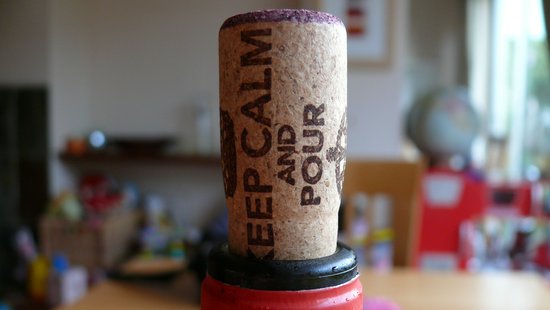
Of all of this infantile knock-off idiot-fodder, though, this is the best I’ve seen. It’s so much better than the rest, in fact, that I believe it’s actually good. Keep Calm & Carignan is a pretty damn good play on words. Whoever came up with it has, I expect, been patted on the back so often and so heartily ever since that he or she is right now off work with a dislocated shoulder. On full pay. Though the cork, regretfully, ruins things a bit.

Whoever came up for it works at Laithwaite’s, my second least favourite wine merchant (dislike based entirely on the way they sell wine, rather than the wine they sell, the very great majority of which I have no experience of at all). But even if the label is a joke, the wine isn’t: it comes from Fitou, smells of hot places, tastes of prunes and tar and liquorice, and is absolutely perfectly good. What’s more, it made very merry work of being drunk alongside some Turkish-style grilled meats. For £9.99 you might be paying a quid for someone’s clever idea, but they deserve it.

Perhaps this will be the first of a series with names modelled on famous slogans and phrases. Just in case, here are some more ideas for you, Mr Laithwaite. They are my gift to you, feel free to use them*: Have a Break, Have a Muscat; A Marsanne a day helps you work, rest and play; Napa Crackle Pop; Happiness is a Cigales called Hamlet; No Chianti, No Comment; And all because the lady loves St-Peray; For a few dollars Mourvedre; Blaufrankischstein’s monster; It takes two Tarrango; Go to work on a vodka.

*Though I may actually sue if you do.

Terras Gauda’s mighty whites

While many people continue to believe that wine is a fusty old world never touched by fashion, they could hardly be more wrong. Many Bordelais might make and sell wine much as they did generations ago, but there are fads and trends  just like anything else, and a long-ignored corner of north-west Spain currently finds itself trending wildly. For reds there is Bierzo, a little splot that mainly makes wines from the mencia grape. Three years ago if you wanted to try one you’d have to hopefully call around specialist merchants like JR Hartley in search of his book about fly fishing; now they sell it in Waitrose. But for all Bierzo’s current hipness, and I’ll be reviewing a couple of them in a week or two, north west Spain’s greatest hit is surely the albarinos from nearby Rias Baixas.

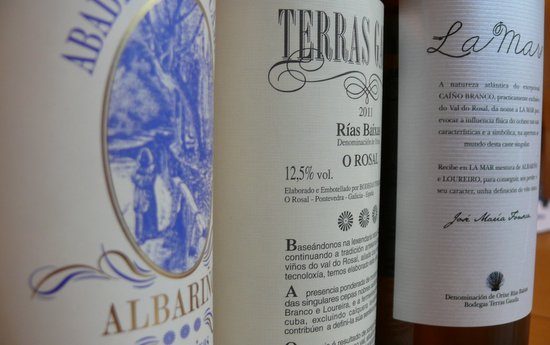
Here are three from Terras Gauda, a Spanish winery who have clearly taken aim at the UK’s social media, having dispatched a selection of their wines to a decent handful of writers and bloggers, including myself (for variety, here’s Jamie Goode, Tom Cannavan, The Cambridge Wine Blogger and The Wine Rambler). Fortunately, they are worth publicising, and a couple of their whites had a taut, elegant freshness that place them among the best I’ve had from the region. If we were ever to get a summer, I could think of few better ways of toasting it.

That leaves one, and La Mar stood out for several reasons. It is a wine to get a wine buff in a lather: a dense, oily, rich, expressive, golden brew that instantly prompted a long list of descriptors, with orange blossom underlined on my list. It is also made primarily of a thrillingly obscure grape, caino blanco. It’s fine stuff, but – and this is crucial – in my mini-tasting it was still half-full when the other two bottles had been drained. It’s good, but something to enjoy as a background flavour while eating some fairly gutsy, perhaps creamy food. It’s good in the way that The Only Way is Up by Yazz & The Plastic Population is good – in small doses, or turned down quite low while you also do something else.

The other two, as well as being, frankly, easier to drink, also have the advantage of being considerably cheaper. The most basic bottle, Abadia de San Campio, is still not exactly bagainous at upwards of £13, but it’s a classy glass. It had a salinity and minerality to it that I find extremely beguiling, and a lemon-zest freshness. O Rosal was slightly more understated on the nose, but opened up to offer more herbal flavours and some tart green apple. It’s a little more expensive at around £15, but was my favourite of the three on a photo finish. For a similar price, just to prove that I’m not only nice about wines I get sent for free, I’ve also recently enjoyed the albarino from Pazo de Senorans. These wines are fashionable for a reason.


A couple of party picks

20120618-101646.jpg

Yesterday was Mrs CF’s birthday, leading to a small boatload of people hotfooting it to CF HQ expecting sustenance and refreshment. Sustenence took a form that would have made even the most ill-informed nutritionist feint with shock, involving as it did ludicrously indulgent brownies, wobbly jelly, two flavours of home-made ice cream (caramel popcorn and chocolate & hazelnut, since you ask. Incidentally, if you want to make ice cream and don’t own either this book or its successor, sort it) one booze-packed sorbet (gin & tonic, since you ask), and an unfortunate array of chemical-packed sweets, plus a scant handful of assorted berries and an emphatically ignored selection of carrot sticks.

Then there was the booze. I’m ordinarily an adventurous wine drinker, but parties aren’t a time for risks – you want something young, fresh, utterly reliable and light on both tongue and wallet. I had a white and a pink on the go, the former being Quinta de Azevedo Vinho Verde – fresh, spritzy, relatively light in alcohol at 11.5% and very widely available (currently £6.75 at the Wine Society, £6.49 at Majestic – on promotion from £7.49 – and £7.49 at Waitrose, though I bought it in their recent 25% off promotion for £5.61), it’s a superb default summer party white that all of those retailers have stocked for years.

The pink fulfilled the same criteria. I love Muga’s rosado, which has a super, aluring just-pink colour, a hint of tart berry fruit and tingly freshness. It’s extremely hard to tire of, but sadly the Spanish seem to have achieved it, Riojan rosé being seen as decisively unhip in Iberia at present. On the down side, they’re losing out on some tasty wine that they can buy for a song (This one can be had for €5.70 on this Spanish website, which works out at £4.60) and failing to support their local businesses. On the plus side, that leaves a lot more for us.

Interesting trivia: Jorge Muga, current scion of the winemaking clan, and indeed anyone else from that part of Spain, calls this style of wine “clarete”, but they can’t put it on the bottle because it’s not from Bordeaux, whose viticulturalists have asserted ownership of the word claret and all its variants in all vinous contexts. And unlike most pinks outside Champagne, it’s made by mixing white wine and red wine. Anyway, it’s delicious, if a bit more expensive than the Vinho Verde at £9.49 (Waitrose) and £8.49 (on promotion from £9.99, Majestic).

Incidentally, I went to Muga’s website to see if they could tell me anything more about this wine. This is what I got: “Its period left on the lees underpins the acidity in such a way that its presence is obvious but not intrusive, thanks to the softening influence of the polysaccharides. As you sip it your mouth seems to fill with sweet, chewy fruit. As it passes over the palate the sensations move towards sharp apples, before ending in the retronasal phase with a total dominance of white blossom and ripe fruit.” Polysaccharides? Retronasal phase? Crikey!

Most of my friends aren’t wine lovers, know that I’ll sort them out with something decent to drink, and turn up empty handed. This is good for everyone. One, though, turned up yesterday with a bottle of Gallo White Zinfandel Rose. I try not to be a total wine snob, but I’ve got to draw the line somewhere; they ain’t coming next year.

A remarkable act of generosity

The Red Lion & Sun is situated about half-way between my old house in Archway and my new one in East Finchley, not more than a couple of miles away from either, but it took me a few years to discover it. Located as it is very close to the part of Highgate village that is lovely to stroll around, without actually being in that part of Highgate village, it always used to lose out to the better-located but, as it turned out, markedly inferior Angel Inn or Flask. I was missing out, big time.

As usual, my stomach led me to their door. The first time I went the then much-hyped Meatwagon was parked in the front garden. I liked what I saw, and have been back regularly since. There’s plenty of space outside but not a lot inside, most of which is bar, most of which is dedicated to displaying their bulging whisky collection. It’s cosy, there’s a very fine fire that roars through the winter. They make very good but very unfussy food at reasonably prices and without fuss. It’s quietly, unpretentiously excellent.

A few weeks ago the current owners celebrated the fifth anniversary of their taking control, by throwing a party. They roasted a pig, and for good measure, they also roasted a lamb. That was enough to grab my attention.

There was a DJ in the front garden, playing loud disco music. The bad news ended there: the meat was served in buns, with a fistful of salad leaves. It was delicious, and it was free. I went to the bar, and ordered a couple of pints. They were free also. The atmosphere was startlingly friendly. People were actually talking to strangers.

I was astonished by this act of generosity. They could have charged a couple of pounds for a plate of food, and everyone would have felt that they had themselves a bargain. They could have charged a pound or two for a drink, and everyone would still have been rubbing their hands with glee. But they gave it all away, and this can mean one of two things: either they’ve got no business sense and the entire enterprise is doomed, or they truly understand how to make customers feel valued, and everyone who was there will come back often enough to repay them several times over. I know I’ll be back; I just hope they’re still open when I get there.

The last bargain in Bordeaux

20120509-200821.jpg

The 2011 En Primeur season is in full swing, or at least mild rock. A runt after two prodigies (the stellar 2009 and 2010 vintages), who is actually buying this stuff despite often token price reductions is frankly beyond me. Bordeaux is a fascinating region, producing some of the finest wines in the world in a variety of styles (as well as, whisper it, oceans of plonk), but they’re doing their best to scare away lower and even middle-brow wine consumers with their eyebrow-arching asking prices. I don’t mind; whoever’s able to buy it is welcome to it, there’s plenty more bottles on the shelf and all that. But before I turn my back on Bordeaux, there is one en primeur investment I wouldn’t want to miss out on.

I’m never, or at least extremely rarely, going to sup Pontet Canet or Conseillante or their ilk on a night out with pals. They have built their gilded castles way, way beyond my wine-buying horizon. But for one afternoon each year I can tilt my glass with the big boys for a song. This is Bibendum’s annual en primeur tasting, attended by literally hundreds of chateaux, each of them bringing their latest vintage and an older one of their choice, by way of comparison. And a ticket costs £40 (up from £30 last year, but still a steal). Not only that, the wines often come in the hand luggage of the winery’s actual owner. So today, on the day his latest wine was released to the market, Pontet Canet’s Alfred Tesseron, whose product over the last five or so years has risen from relative obscurity to unanimous acclaim, was pouring me – me – his wine and asking for my opinion.

20120509-201058.jpg

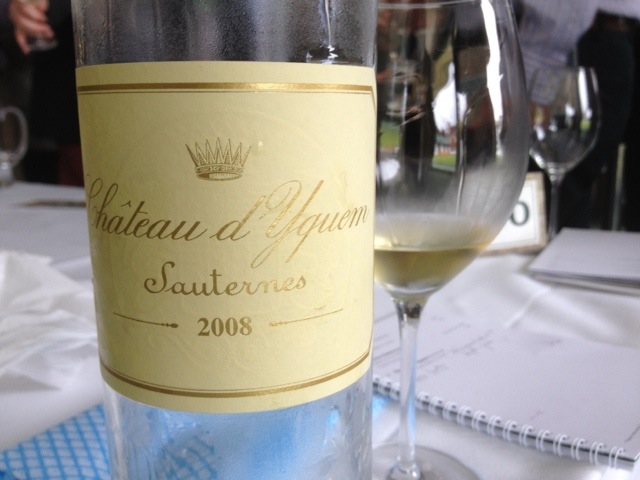
Here’s Pierre Lurton, manager of Chateau d’Yquem – Chateau d’Yquem! – pouring anyone who looks interested a generous slurp of his fabled liquid. It’s the 2008, not rated among the finest vintages but still knocking on the door of £200 a bottle retail. How much would a glass of this set you back in any other establishment, let alone with it being poured by the man in charge? A lot, readers, is the answer. I’d never tasted Yquem before, and my two samples (I admit it, I went back for seconds) were worth £40 on their own.

20120509-201121.jpg

I’m basically hard-wired to dislike things everyone says I should like. It comes naturally to me. So it pains me to have to say that this wine – less stellar vintage be damned – is among the finest things to which my mouth has ever been introduced. It is the type of stuff that would get any wine-lover reaching for The Great Big Book of Overblown Guffoonery. It is harps and choirs of angels and sunrise over the Sea of Galilee, juiced and bottled and poured and sipped.

I tasted some excellent 2011s, but my wallet’s staying in my pocket for this one. At the cheaper end, the one I shop at, it’s best to buy only in the good years. Whether 2012 will come to be ranked among them remains to be seen: this year’s grapes are still babies, with months of growth in still uncertain conditions to come before anyone considers them ready for picking. But I can tell you one thing about the new vintage already: when the Chateaux come to London to show it off, I’ll be first in the queue.